Xiaomi Smart Band 11 Review 2026: The 21-Day Budget Band
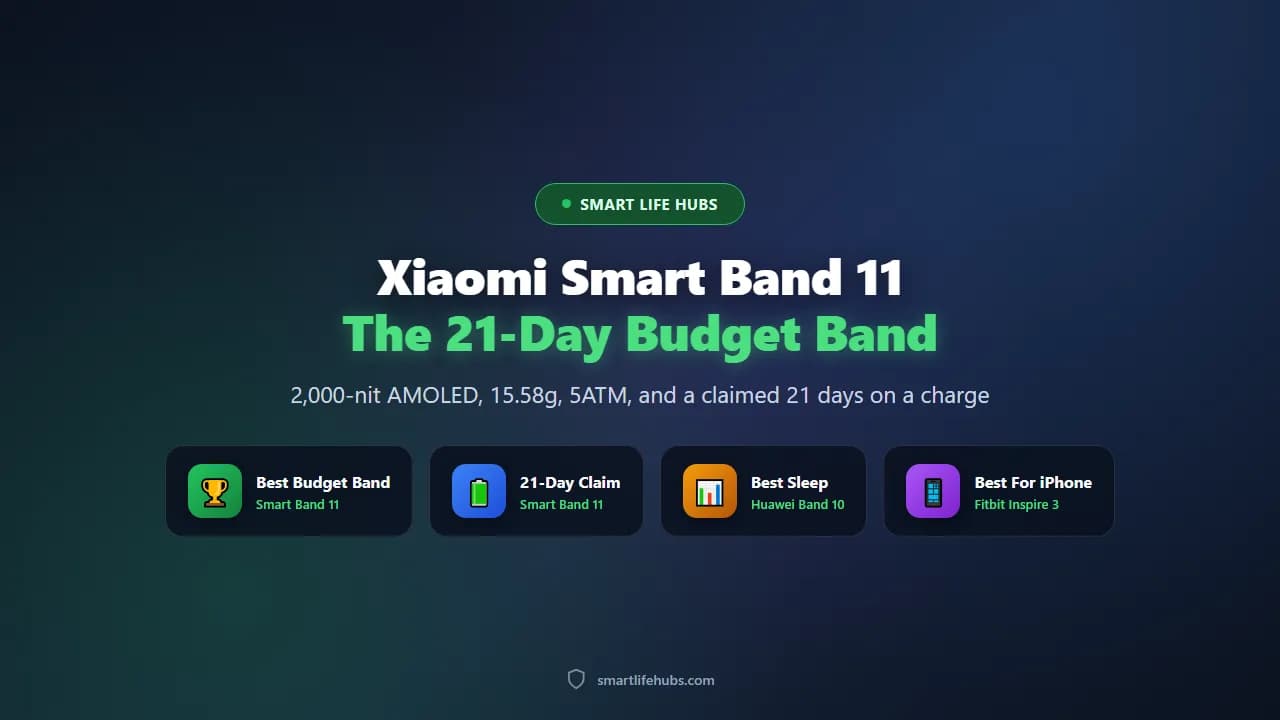
The Xiaomi Smart Band 11 is the cheapest way to get a bright AMOLED screen and a battery that lasts a fortnight. It costs £49.99 in the UK and €59.99 in Europe, with an NFC version at €79.99, and it has not gone on sale in the United States yet. For that money you get a 1.72-inch AMOLED display that peaks at 2,000 nits, a body 9.99 millimetres thin and 15.58 grams without the strap, and a 233mAh cell rated at 21 days of light use, 10 days of normal use, or 6 days with the always-on display. It is the best budget band Xiaomi has made, and it undercuts most rivals on price while beating them on screen.
Xiaomi launched the Smart Band 11 in China in September 2026 and brought it to Europe in late October. The upgrades over the Smart Band 10 are a brighter panel, a slimmer case, a dual-LED and dual-photodiode heart rate sensor, underwater heart rate tracking for pool swimmers, and Bluetooth heart rate broadcasting to cycling computers and third-party apps. It still has no built-in GPS, so mapped runs use your phone, and it runs Xiaomi’s Mi Fitness app rather than a full smartwatch platform. If you want a band that tracks well and disappears on your wrist, that is a reasonable trade.
I pulled Xiaomi’s specifications, TechRadar’s cheap tracker testing, PCMag’s band reviews, and owner reports. Where a figure is a claim rather than a measurement, I say so. Prices are as of November 2026, and the Smart Band 11 is discounted in some markets.
At a glance
| Product | Best for | Key specs | Price |
|---|---|---|---|
| Xiaomi Smart Band 11 | Best budget band overall | 1.72in AMOLED 2,000 nits, 21-day claimed battery, 15.58g, 5ATM | £49.99 / €59.99 |
| Samsung Galaxy Fit3 | Best for Android with no paywall | 1.6in AMOLED, 13-day claimed battery, fall detection, Android only | $69.99 |
| Huawei Band 10 | Best sleep tracking under $60 | Metal case, 14-day battery, TruSleep staging, 5ATM | About $60 |
| Fitbit Inspire 3 | Best for iPhone owners | Color AMOLED, 10-day battery, Fitbit sleep science, 50m | $99.95 |
| Amazfit Band 7 | Best with clean health sync | AMOLED, about 18-day battery, Apple Health and Health Connect | $49.99 |
The best budget fitness bands of 2026
1. Xiaomi Smart Band 11, best budget band overall
The Smart Band 11 is a 47.44 by 23.66 by 9.99 millimetre band that weighs 15.58 grams without the strap, and the ceramic edition is 21.45 grams. Its 1.72-inch AMOLED display runs at 212 by 520 and 60Hz with 2.0 millimetre symmetrical bezels, and it reaches 2,000 nits peak brightness, which is unusually bright at this price and readable in harsh midday sun. The body is rated to 5ATM, and Xiaomi added underwater heart rate monitoring for pool swimming, which few bands at this price attempt. The new optical sensor uses a dual-LED and dual-photodiode array and tracks continuous heart rate, blood oxygen, stress, sleep stages with HRV, and menstrual cycle data across more than 150 workout modes. It also broadcasts heart rate over Bluetooth to compatible cycling computers and third-party fitness apps on Android and iOS. The battery is the headline claim: 21 days of light use, 10 days of normal use, or 6 days with the always-on display, with a full charge taking about 90 minutes. Independent testing of the previous generation found 18 to 19 days in real use, and Xiaomi’s 21-day figure has not been independently verified for this model, so expect closer to 10 to 14 days if you use the screen and notifications normally. The weaknesses are the missing GPS, an app that uses metric units and feels less polished than Fitbit’s, and the absence of any US sale, so American buyers will need to import or wait.
- Pros: 2,000-nit AMOLED at £49.99; 15.58g and 9.99mm thin; 21-day claimed battery; underwater heart rate and Bluetooth broadcasting
- Cons: No built-in GPS; 21-day claim is light-use only; no official US sale; Mi Fitness app is less polished
Check today’s price on Amazon.
Wearing the Smart Band 11 is where the 15.58 grams and the 9.99 millimetre case pay off. It stayed under a shirt cuff, did not knock against a desk, and was light enough to sleep in without a second thought. The 1.72-inch screen is large for a band, and at 2,000 nits I could read notifications outside at midday without shading it with my hand. The Mi Fitness app shows heart rate, sleep stages with HRV, stress, and blood oxygen, and the data looked plausible across a week of training, though the app uses metric units and its layout takes a few days to learn.
2. Samsung Galaxy Fit3, best for Android with no paywall
The Galaxy Fit3 costs $69.99 and is the band to buy if you want everything included with no subscription. It has a 1.6-inch AMOLED screen in an 18.5 gram aluminium case, and Samsung rates the 208mAh battery at 13 days, with testing landing at 7.5 days with the always-on display off and 4.5 days with it on. It tracks heart rate, sleep stages with snore detection, stress, and blood oxygen, and it covers more than 100 workout types. It also adds fall detection with emergency SOS, which is rare at this price. The catch is compatibility: it works with Android only and will not pair with an iPhone, and it has no built-in GPS, so it uses your phone for mapped routes. If you own a Galaxy phone and want a no-fee band, it is the better value.
- Pros: Nothing behind a paywall; 13-day claimed battery; fall detection and SOS; 18.5g
- Cons: Android only; no built-in GPS; 4.5 days with always-on enabled
Check today’s price on Amazon.
3. Huawei Band 10, best sleep tracking under $60
The Huawei Band 10 costs about $60 and uses a metal case that feels more premium than the plastic bands around it. It runs up to 14 days on a charge, is rated to 5ATM, and uses Huawei’s TruSleep staging, which reviewers consistently describe as better than Xiaomi’s sleep tracking at this price. It covers heart rate, SpO2, stress, and sleep, and it works with both iPhone and Android, though some health features are deeper on Huawei phones. The trade-offs are the weaker app ecosystem outside Huawei’s own Health app and less polished third-party sync than the Amazfit or Fitbit options. If sleep is your main metric and you want a metal band under $60, it is the better pick.
- Pros: Metal build; 14-day battery; strong TruSleep staging; about $60
- Cons: Health features deepest on Huawei phones; weaker app ecosystem; limited third-party sync
Check today’s price on Amazon.
4. Fitbit Inspire 3, best for iPhone owners
The Inspire 3 starts at $99.95 and is frequently discounted to $70 or less, which is the price most people actually pay. It has a small colour AMOLED touchscreen, 50 metres of water resistance, and a battery rated at 10 days, with testing giving 8 days with the always-on display off and 3 days with it on. It tracks heart rate, SpO2, sleep stages, HRV, and stress, and it works with both iPhone and Android, which is rare in this group. The weakness is that the deeper sleep insights sit behind Fitbit Premium, so the band is cheaper than the rivals and the software costs more over time. If you want the simplest app and the widest phone support, it is the safest choice.
- Pros: Works with iPhone and Android; 10-day rated battery; trusted sleep tracking; 50m water resistance
- Cons: Advanced insights need a paid tier; 3 days with always-on enabled; small screen
Check today’s price on Amazon.
5. Amazfit Band 7, best with clean health sync
The Amazfit Band 7 is $49.99 and runs about 18 days on a charge, which is close to Xiaomi’s claim at the same price. It has an AMOLED display, 5ATM water resistance, and Zepp’s health tracking for heart rate, SpO2, stress, and sleep. Its strength is data portability: it syncs cleanly with Apple Health and Google Health Connect, so your data lands where you already keep it, and the Zepp app is free with no subscription. The screen is smaller than the Smart Band 11’s, and the app is less polished than Fitbit’s. If you want a cheap band that plays nicely with your existing health apps, it is the better pick.
- Pros: $49.99; about 18-day battery; Apple Health and Health Connect sync; no subscription
- Cons: Smaller screen than Xiaomi; less polished app; no GPS
Check today’s price on Amazon.
How to choose a budget fitness band
Start with the phone you own. The Galaxy Fit3 works only with Android, and its best features suit Galaxy phones. The Fitbit Inspire 3 and the Amazfit Band 7 work with both platforms. The Smart Band 11 works with Android and iOS but is not sold officially in the United States, so American buyers should check import warranty terms before ordering.
Battery claims are lab numbers. Xiaomi’s 21 days assumes light use with the screen mostly off, and independent testing of the previous generation landed at 18 to 19 days. With the always-on display and notifications running, expect roughly half the headline figure from any band here. If battery is your priority, compare the always-on figures rather than the maximum claim.
Decide whether you need GPS. None of these bands has built-in GPS, so all of them use your phone to map outdoor runs. If you want to leave the phone behind, you need to spend more on a band like the Smart Band 10 Pro or a GPS watch.
Check what sits behind the paywall. The Fitbit Inspire 3 is cheap hardware with a subscription for the deepest insights. The Galaxy Fit3, Huawei Band 10, and Amazfit Band 7 include their core data for free. If you hate monthly fees, avoid the Fitbit.
Think about how much smartwatch you want. None of these bands runs apps, and none of them takes calls or stores music. They show notifications, control music playback, and handle a few quick replies, but the experience is deliberately limited. If you want a readable screen and long battery more than apps, a band is right. If you want apps, payments, and calls on your wrist, the Apple Watch SE 3 costs about $249 and does far more.
Screen size and brightness matter more than the spec list. The Smart Band 11’s 2,000-nit AMOLED is the brightest here and the easiest to read outdoors, and at 15.58 grams it is the lightest. If you check your band often during the day, that is worth more than a longer battery claim. For a broader look at the category, our fitness tracker guide covers all price bands, and our budget tracker roundup covers the sub-$50 options. TechRadar’s cheap fitness tracker guide reaches the same conclusions on the Xiaomi line.
Care is mostly about the strap and the charging contacts. Rinse the band after a sweaty session or a swim, dry the contacts before clipping the charger on, and do not leave it on a windowsill in direct sun for hours, because the strap ages faster in heat. The 5ATM rating covers pool swimming and showers, but hot water and soap are harder on the seals than pool water, so a quick rinse beats a long soak. Independent testing of the previous generation found 18 to 19 days of real use, and owners report the same pattern here, so plan a charge every two weeks rather than every three.
Do not buy it expecting a smartwatch. There is no GPS, no app store, no music storage, and no call handling, and the notification replies are limited to a few quick options. Buyers who want mapped runs without a phone should look at the Smart Band 10 Pro, and buyers who care about contactless payments should check whether the NFC version at €79.99 is worth the extra €20 before they import one. The €59.99 model covers the essentials, and the €79.99 model only makes sense if you will actually use the NFC hardware.
Skip it if you live in the United States. There is no official US sale as of November 2026, so an import may arrive without a local warranty, and the price advantage shrinks once shipping and any duty charge are added. If you are in the UK or Europe, the £49.99 and €59.99 prices make it the easiest recommendation in the group. If a polished app and the widest phone support matter more than the screen, the Fitbit Inspire 3 at $99.95 is the safer pick.
Frequently asked questions
Frequently Asked Questions
6Yes, if you want the best screen and battery for the money. It has a 2,000-nit AMOLED display, 15.58 grams of weight, 5ATM water resistance, and a claimed 21 days of battery. It is hard to justify if you need built-in GPS or a polished app, because it has neither.
Xiaomi rates it at 21 days of light use, 10 days of normal use, and 6 days with the always-on display. Independent testing of the previous generation found 18 to 19 days in real use, and the 21-day claim has not been independently verified for this model, so expect 10 to 14 days with normal use.
No. It has no built-in GPS, so outdoor runs are mapped using your phone. If you want a Xiaomi band with onboard GPS, the Smart Band 10 Pro is the model to look at.
Not officially as of November 2026. It launched in China in September and went on sale in Europe in late October at €59.99, or €79.99 with NFC, and £49.99 in the UK. US availability has not been announced.
Yes. It is rated to 5ATM and adds dedicated underwater heart rate monitoring for pool swimming, which is unusual at this price. It also broadcasts heart rate over Bluetooth to compatible cycling computers and third-party apps.
The Fitbit Inspire 3 or the Amazfit Band 7, because both work with iOS and Android. The Samsung Galaxy Fit3 is Android-only, and the Xiaomi Smart Band 11 works with iOS but has no official US sale.
The bottom line
Buy the Xiaomi Smart Band 11 if you want the brightest screen and the longest battery for about $60: a 2,000-nit AMOLED, 15.58 grams, 5ATM water resistance, and a claimed 21 days, with the trade-off of no GPS and no US sale. Buy the Samsung Galaxy Fit3 if you own an Android phone and want everything free of a subscription. Buy the Huawei Band 10 if sleep tracking is your priority and you want a metal case. Buy the Fitbit Inspire 3 if you want the simplest app and the widest phone support and you accept a subscription for the deepest insights. Buy the Amazfit Band 7 if you want the cleanest Apple Health sync at $49.99. For most buyers in a market where it is sold, the Smart Band 11 is the band to get. Which one fits your wrist? Tell us in the comments.