Pulsetto FIT X Review 2026: 12-Day Battery Vagal Toning Tested
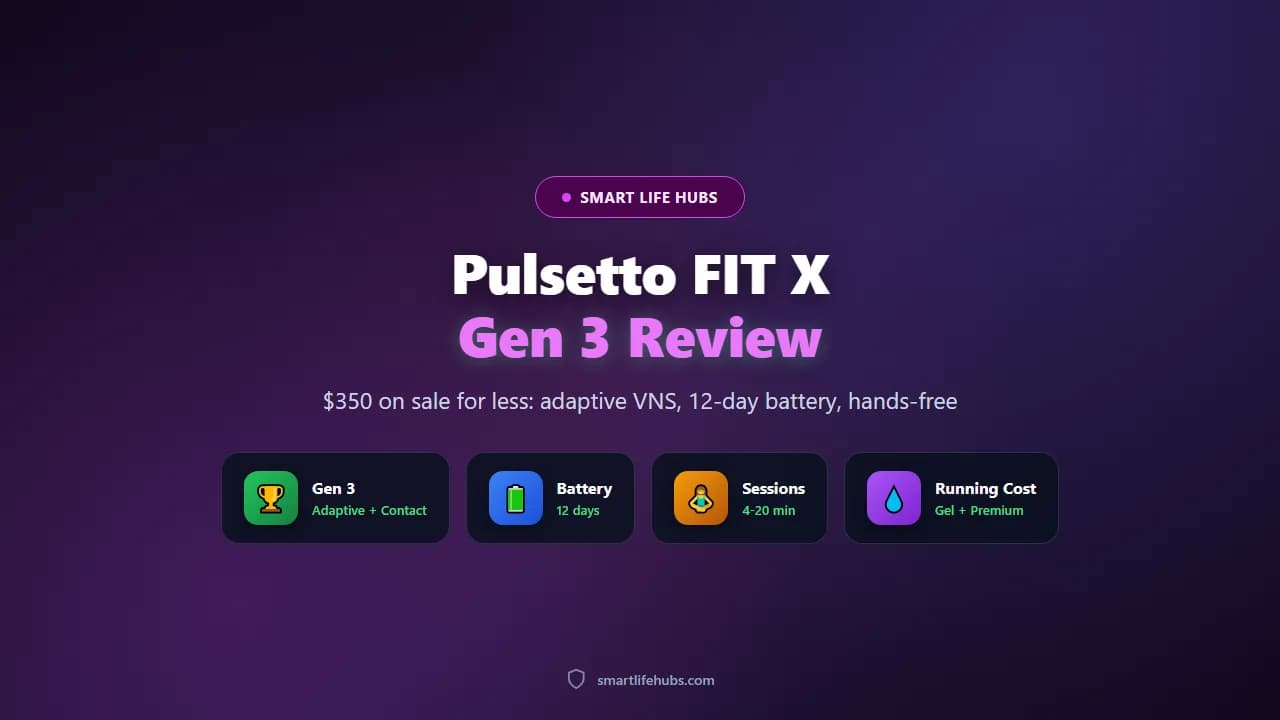
The Pulsetto FIT X is the third generation of Pulsetto’s neck-worn vagus nerve stimulator, and the changes are practical rather than radical. It keeps the same collar design that wraps around the back of the neck and sends low-level electrical pulses toward the vagus nerve through the skin. What is new is adaptive stimulation that adjusts intensity during a session, contact sensing that confirms the electrodes are on your skin before it starts, a glowing signal ring, vibro-tactile cues, wider electrodes, and a battery rated at up to 12 days, up from 10. It is priced at $350 and frequently on sale for $296 to $323.
Pulsetto is blunt that the FIT X is not a medical device. It carries FCC certification, which covers radio emissions and says nothing about health effects, and the product page cites no study. The evidence for non-invasive vagus nerve stimulation exists, but it depends heavily on the stimulation site, the parameters, and the condition being studied, and nothing ties Pulsetto’s exact settings to a measured outcome. Judge this as a wellness gadget with a pleasant ritual, not a treatment. Cybernews’ independent FIT X review reached the same conclusion after several weeks of use, rating it 4.7 out of 5 for ease of use while noting the thin evidence base.
I pulled the manufacturer specifications, Amazon’s listing, and independent reviews from Cybernews, Wareable, and Droid Gadgets. Where a figure is a company claim rather than a measurement, I say so. Prices are as of November 2026 and Pulsetto runs frequent promotions.
At a glance
| Spec | Detail |
|---|---|
| Price | $350 list, commonly $296 to $323 on sale |
| Type | Transcutaneous cervical vagus nerve stimulation, bilateral |
| Battery | Up to 12 days per charge, USB-C, about 1 hour to full |
| Intensity levels | 15 |
| Free programs | 5: Sleep, Stress, Focus, Release, Calm |
| Premium programs | Recovery, Gut, Head, Personal, about $45 per quarter |
| New in Gen 3 | Contact sensing, adaptive stimulation, vibro-tactile feedback, signal ring, wider electrodes |
| In the box | Device, USB-C cable, 1 fl oz gel with applicator |
| Warranty and returns | 2 years, 30-day money-back |
Design and comfort
The FIT X is a 60-gram band that sits around the back and sides of the neck. It is lighter than it looks and small enough to keep in a drawer, and the build feels more finished than the older FIT, with a softer inner surface and a single glowing ring on the outside that changes state as you set up. The wider electrodes are the most visible hardware change and they matter more than the marketing suggests, because they give a larger contact area and make it easier to get a consistent session without chasing the position.
Comfort is the selling point. You put a thin layer of gel on the electrode pads, wrap the band around your neck, and start a program from the app. There is nothing to hold, nothing to insert, and nothing to strap to a wrist or ankle. You can read, work, or watch television through a session. The contact sensing is the feature that makes it feel reliable, because the device refuses to run until it detects skin contact, and it warns you if the contact slips mid-session. The vibro-tactile cues confirm the start and end of a program without needing to look at your phone.
The trade-offs are the gel and the look. The conductive gel is a consumable you must reapply, and a 1 fluid ounce tube ships in the box and covers roughly 30 days of daily use. The band is visible on your neck, so it is not something you would wear to a meeting. It also cannot be used while charging, so you cannot run a session from a dead battery.
Fitting the band and finding a position
The band wraps around the back and sides of your neck, with the electrode pads on the inner surface. The first session is mostly about finding a position where both pads sit flat against clean skin. Put on a thin layer of gel, wrap the band, and let the contact sensing confirm the connection before you press start. The signal ring shows the state as you set up, and the vibro-tactile cues mark the start and end of the program, so you do not need to watch the phone. If the band shifts when you move your head, adjust the fit rather than adding more gel.
What a session feels like
Start at the bottom of the 15 intensity levels and move up until the sensation is clear but not sharp. At a low setting most users describe a light tingling or tapping under the pads, and the adaptive mode adjusts the output during the session rather than holding one level. If the sensation drops off, a pad has usually moved or the gel has dried; reseat the band and add a small amount of gel rather than pushing the intensity higher. A 4-minute program is short enough to run while reading, which is most of the point.
Programs, app, and subscription
The free app offers five programs. Sleep runs 10 minutes and is meant to be used about half an hour before bed. Stress, Focus, and Release run 4 minutes, and Calm is a general relaxation program. Five free programs is enough to judge the device, and most owners use one or two of them most days. The 15 intensity levels give you room to find a setting that is noticeable without being uncomfortable, and the adaptive mode adjusts within a session rather than making you set it once.
Premium adds Recovery, Gut, Head, and Personal programs plus breathing exercises and wellness insights, at about $45 a quarter after a free trial, which works out to $180 a year. That is a meaningful addition on top of a $350 device, and the honest advice is to use the free programs for a month before you pay anything. The offline mode is new and useful, because you can run a program without your phone nearby, and firmware updates are free for life.
The five free programs in practice
Sleep is the program most people will use. It runs 10 minutes and is designed for about half an hour before bed, so it fits into a wind-down rather than replacing one. Stress, Focus, and Release each run 4 minutes, short enough to use at a desk, and Calm is the general option for settling down. Five programs sounds limited, but most owners settle on one or two and use them daily. That is why the free tier is enough to judge the device, and why the adaptive mode matters more than the number of programs.
What Premium adds, and when it is worth it
The premium tier is a variety purchase. Recovery, Gut, Head, and Personal add programs for specific situations, and the breathing exercises give the device a guided option the free tier does not have. At about $45 a quarter, the first year costs $180, more than half the list price of the device. Run the free five for a month first and note whether you miss anything. If you use the device daily and want variety, Premium is reasonable; if you use one program, it is wasted money. The subscription recurs, so the cost continues even when the device is in a drawer.
Battery life and charging
Pulsetto rates the FIT X at up to 12 days per charge, up from 10 days on the FIT, and a full USB-C recharge takes about an hour. Independent testing is thin, but one reviewer who used it three times a day for 10 minutes each reported the battery lasting about as long as the company’s estimate. In normal use, a 4-minute session twice a day should comfortably clear a week and likely reach the 12-day claim. The band charges from a standard USB-C cable, so you do not need a proprietary dock, and the battery indicator in the app warns you before it runs out.
Charging habits and storage
Charge the band fully before the first session, and top it up when the app indicator warns rather than running it to empty. A full USB-C recharge takes about an hour, and the band cannot be used while it charges, so pick a time when you are not planning a session. In a routine of two 4-minute sessions a day, the 12-day estimate means roughly two charges a month, which is easy to keep as a habit. Store the band somewhere dry and out of direct sun, and keep the USB-C port free of gel and dust.
What works and what does not
What works is the ritual. A 4-minute session is short enough to do every day, the hands-free design removes the friction that kills most wellness devices, and the contact sensing makes it feel like a product that has been thought through. The battery life means you charge it roughly twice a month. The offline mode and the free programs mean you are not locked into a subscription.
What does not work is the evidence and the ongoing cost. Pulsetto calls the device clinically proven in its marketing, but the product page cites no study and makes no FDA statement, and the FCC certification is about radio emissions. The gel is a running cost at about $12 a tube or $45 for a four-pack. The Premium tier is expensive relative to the device. Amazon reviews are thin and average 3.0 out of 5 on a handful of ratings, which tells you more about sample size than quality. If you want a device with published product-specific research, the Nurosym ear device has a stronger trial record, and it is covered in our vagus nerve stimulator roundup.
Care and common mistakes
Looking after the electrodes and the gel
Wipe the electrode pads after each session with a soft, slightly damp cloth and let them dry before the next use, and keep gel off the outer shell and the charging port. A thin layer is enough; more does not improve the connection. The 1 fluid ounce tube in the box covers about 30 days of daily use, so budget for replacements. If the band will not be used for a while, charge it to roughly half and store it in a drawer rather than leaving it on a charger.
Mistakes new owners make
Starting at a high intensity is the most common mistake. The 15 levels exist so you can find a comfortable setting, and a strong sensation is not a better one. Using too much gel lets the pads slide and triggers the contact sensing. Expecting a medical result is the third: Pulsetto says the FIT X is not a medical device, and the FCC certification covers radio emissions, so judge it as a relaxation ritual. Forgetting that it cannot run while charging catches people out. Use the 30-day return window; the two-year warranty covers defects, not a month of free use.
Is the FIT X worth buying?
Buy it if you want a hands-free daily habit. The FIT X is the most convenient way to run a short vagal toning session, because you put it on, press a program, and carry on. If you are the kind of person who abandons devices that need setup, the collar design and the 12-day battery are the argument for it.
Do not buy it for a medical outcome. It is a wellness device with no product-specific clinical evidence. If you have a condition such as migraine, epilepsy, depression, or a heart rhythm problem, talk to a doctor, and be aware that people with pacemakers or implanted electronic devices are told to consult a clinician first.
Use the free programs before you pay for Premium. Five programs cover the realistic use cases, and the $45 quarterly tier should be judged after a month of real use, not before.
Count the gel. A tube lasts about a month, so budget roughly $12 to $15 a month if you use it daily. That is a small but real cost on top of the device.
Try it inside the 30-day window. The two-year warranty is generous, but the return window is only 30 days. Use it daily for three weeks and decide, because the benefit, if you feel one, is subjective and personal.
Think about whether you already have a relaxation habit. Slow breathing, humming, cold exposure, and singing stimulate the vagus nerve for free. If you will not do those, you may not do a device session either, and the cheapest option is to start there. Our sleep gadget roundup covers non-device options too.
Frequently asked questions
Frequently Asked Questions
6It lists at $350 and is frequently on sale for $296 to $323. The older FIT is about $296 and the Lite about $269. Pulsetto runs promotions often, so the price you pay is usually below list.
Pulsetto rates it at up to 12 days per charge, up from 10 days on the FIT. A full USB-C recharge takes about an hour, and the device cannot be used while charging.
No. The app offers five free programs, Sleep, Stress, Focus, Release, and Calm, plus offline mode. Premium adds Recovery, Gut, Head, and Personal programs for about $45 a quarter.
No. Pulsetto states that it is not a medical device and that it is not intended to diagnose, treat, cure, or prevent any disease. The FCC certification covers radio emissions, not health effects.
Most users describe a mild tingling or tapping sensation at the electrodes. With 15 intensity levels and adaptive stimulation you can start low and increase until it is comfortable.
The FIT X adds contact sensing, adaptive stimulation, vibro-tactile feedback, a signal ring, wider electrodes, and a 12-day battery against the FIT’s 10. The session lengths and the core programs are similar.
The bottom line
The Pulsetto FIT X is the best version of the most convenient consumer vagus nerve stimulator, and it earns a recommendation on the strength of its design rather than its evidence. You get a 60-gram hands-free collar, contact sensing, adaptive stimulation, five free programs, offline mode, a 12-day battery, and a two-year warranty for $350, often less on sale. The honest caveats are that it is not a medical device, the gel is a running cost, Premium is expensive, and the product-specific evidence is thin. Buy it if you want a short daily ritual you will actually keep, use the free programs first, and decide inside the 30-day return window. If you want published research over convenience, look at Nurosym. Have you tried vagal toning? Tell us what worked in the comments.