Oura Ring 5 vs Ultrahuman Ring Air: No-Subscription Smart Ring Showdown
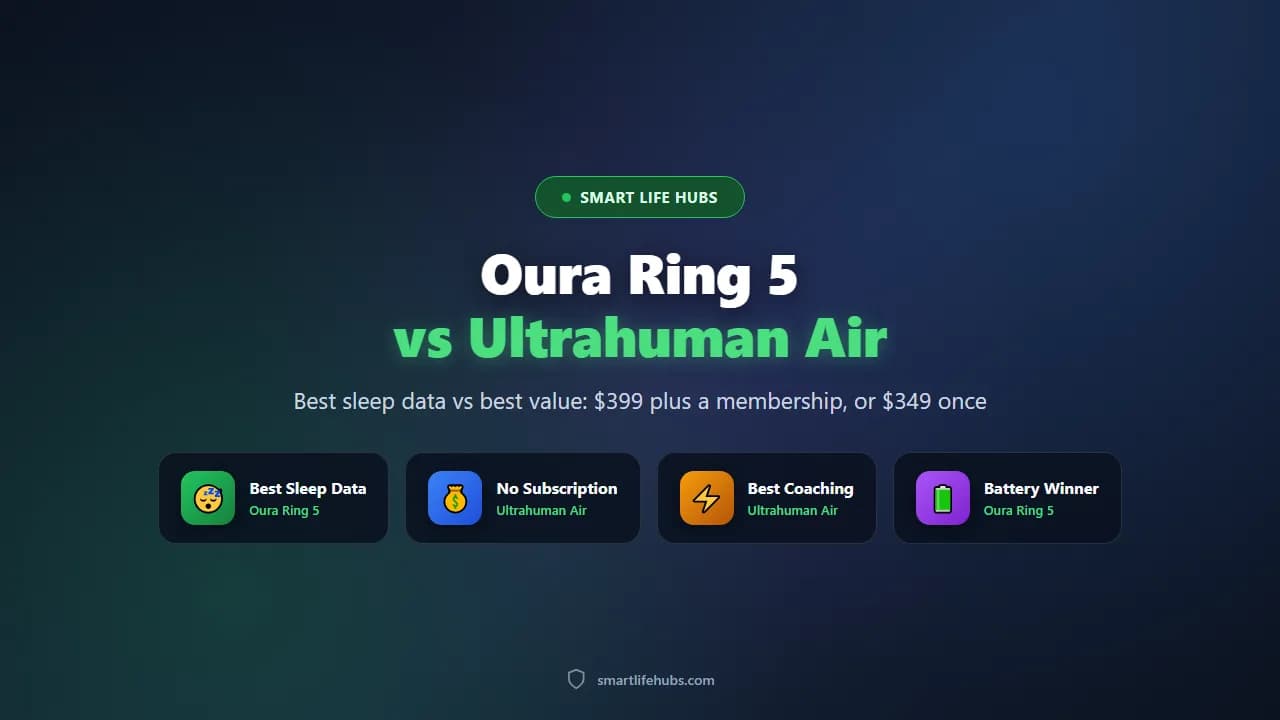
The Oura Ring 5 and the Ultrahuman Ring Air are the two smart rings most buyers end up comparing, and the difference between them is bigger than the price tag. Oura charges $399 for the ring and then $5.99 a month for the insights that make it worth owning. Ultrahuman charges $349 once and asks for nothing more, ever. One is the sleep-tracking reference standard with a membership attached. The other is the best value in the category with coaching that tells you when to have your last coffee.
Both rings are genuinely good. The Ring 5 is 6.09 millimetres wide, 2.28 millimetres thick, and 2 to 2.69 grams, and it tracks more than 50 health metrics including blood pressure signals and nighttime breathing. The Ring Air is 8.1 millimetres wide, 2.45 to 2.8 millimetres thick, and 2.4 to 3.6 grams, and it focuses on recovery, circadian rhythm, and caffeine timing rather than a vast metric library. The choice is not about which ring is better. It is about whether you want the deepest sleep data or the best deal.
I compared manufacturer specifications, Wired’s smart ring roundup, PCMag’s ring testing, and long-term owner reports from Reddit and the Oura and Ultrahuman communities. Where a figure is a claim rather than a measurement, I say so. Prices are US street prices as of November 2026, and the Ring 5 is frequently $100 off during sales.
At a glance
| Criteria | Oura Ring 5 | Ultrahuman Ring Air |
|---|---|---|
| Price | $399 (Silver, Black) or $499 (premium finishes) | $349 for every finish |
| Subscription | Required for full insights, $5.99 per month or $69.99 per year | None; optional PowerPlugs from $24 per year |
| Three-year cost | $615 to $715 | $349 |
| Width and thickness | 6.09mm wide, 2.28mm thick | 8.1mm wide, 2.45 to 2.8mm thick |
| Weight | 2 to 2.69g depending on size | 2.4 to 3.6g depending on size |
| Battery | 6 to 9 days depending on ring size | 4 to 6 days claimed, 3 to 5 in real use |
| Charge time | About 80 minutes on the included dock | About 2 hours on the magnetic puck |
| Water resistance | 100 metres, IP68 | 100 metres, 10ATM |
| Sensors | Two triple LEDs, two photodetectors, temperature, accelerometer | PPG red, green, and infrared LEDs, temperature, 6-axis IMU |
| Sleep features | Stages, score, sleep debt, body clock, chronotype | Stages, score, readiness, circadian rhythm |
| Onboard storage | 3 days | 4 days |
| Best for | Deepest sleep data and long-term trends | Coaching and value without a subscription |
Oura Ring 5 vs Ultrahuman Ring Air: how they compare
Price and subscription
This is the whole argument. The Ring 5 costs $399 or $499 up front and then $69.99 a year for the membership, which over three years totals $615 to $715. The Ring Air costs $349 once and every feature works without a recurring payment. If you stop paying Oura, the app still shows your three daily scores, battery level, and settings, but the trends, sleep breakdown, and long-term insights disappear. If you stop paying Ultrahuman, nothing changes. The optional PowerPlugs, which add AFib detection and cycle tracking, start at $24 each, and you can ignore them entirely. For a buyer who keeps a ring for three years, the Ultrahuman is roughly half the total cost.
Sleep tracking
Oura is the better sleep tracker, and it is not close. It captures brief wake-ups that other rings smooth over, gives you a sleep score with a stage breakdown, and adds sleep debt tracking plus a body clock feature that estimates your optimal sleep window from your chronotype and compares it against when you actually go to bed. Its Health Radar adds blood pressure signals and nighttime breathing patterns, which the Ring Air does not attempt. The Ring Air tracks sleep stages, readiness, and a circadian rhythm score, and it is good rather than great. Owners describe its sleep data as solid but less detailed, and independent comparisons put Oura at the top of the category for staging accuracy. If sleep is the reason you are buying a ring, the Ring 5 is the better instrument.
Coaching and daily guidance
Here the Ring Air fights back. Its circadian rhythm feature suggests your optimal caffeine window from your sleep data, so instead of a score you get an instruction: have your last coffee before two in the afternoon. The Movement Index nudges you to break up long sitting stretches, and the app presents recovery, readiness, and stress in a simpler layout that is easier to act on than Oura’s deep menus. Oura’s strengths are breadth and trends, not daily nudges. If you want a ring that tells you what to do today, Ultrahuman is the more useful device. If you want to understand your body over months, Oura is the better archive.
Design, comfort, and sizing
The Ring 5 is smaller and thinner, at 6.09 millimetres wide against 8.1, and it starts at 2 grams against 2.4. That difference matters on a finger, and most owners describe the Oura as the ring they forget is there. The Ring Air is the wider of the two but still light, and its titanium shell uses a tungsten carbide carbon coating that resists scratches well. Both rings are sized differently from standard jewellery, and both sell a sizing kit. Oura covers sizes 6 to 13 and says the fit differs slightly from the Ring 4. Ultrahuman covers sizes 5 to 14, which is a wider range and helps people with smaller fingers. Order the kit either way, wear the sizer for a day, and confirm before you commit.
Battery and charging
The Ring 5 wins on both claims and convenience. Oura rates it at 6 to 9 days depending on ring size, and a full charge takes about 80 minutes on the included dock, with an optional $99 case that adds up to a month of power. Ultrahuman claims 4 to 6 days, but extended testing found closer to 4 or 5 days in real use, and a full charge takes about 2 hours on the magnetic puck. Neither will strand you, but the Ring 5 asks for a charge roughly once a week while the Ring Air wants one every four to five days. If charging less often is a priority, that is a real quality-of-life difference.
App, ecosystem, and compatibility
Both rings work with iPhone and Android and both sync to Apple Health. Oura integrates with more than 100 apps and offers an extensive metric library, but its app is busier and the good parts sit behind the membership. Ultrahuman’s app is calmer and its core data is free, though the metric library is smaller and there is no blood pressure or nighttime breathing signal. Neither ring has GPS, so both rely on your phone for mapped workouts. Onboard storage slightly favours the Ring Air at four days against Oura’s three, which matters only if you regularly leave your phone behind.
Health sensors and accuracy
Both rings measure the same core signals: heart rate, HRV, skin temperature, blood oxygen, and movement. The Ring 5 uses two triple LEDs covering red, green, and infrared plus two photodetectors and 12 signal pathways, and it rates its own sleep staging at 95 percent accuracy against a sleep-lab study, though that figure comes from Oura’s validation rather than an independent lab. The Ring Air uses red, green, and infrared LEDs, a non-contact temperature sensor, and a 6-axis motion sensor, and its readings have been consistent with Oura in owner comparisons, usually within a beat or two on resting heart rate. Where they genuinely diverge is the extras. Oura adds blood pressure signals, nighttime breathing patterns, and AFib detection. Ultrahuman adds AFib detection only through an optional PowerPlug, and only in certain regions. For resting and overnight accuracy the two are close enough that the decision comes down to which extra signal you will actually read.
Durability and water resistance
Both rings are built for daily wear and swimming. Oura rates the Ring 5 to 100 metres with an IP68 dust rating and a titanium body with a PVD coating on every finish, and it explicitly supports sauna and water sports while warning against scuba. Ultrahuman rates the Ring Air to 100 metres and 10ATM, uses a titanium shell with a tungsten carbide carbon coating, and warns against sustained submersion beyond 12 hours. Owners report scratches on both, usually on the inner sensor dome, and both companies sell rings in enough finishes that a darker colour hides wear better. Neither ring is cheap to repair, so a sizing kit and a good fit matter more than usual.
Which one should you buy
Buy the Oura Ring 5 if sleep is the metric you would pay to perfect. It has the best sleep staging in the category, sleep debt and body clock insights, and Health Radar signals no rival here offers. Accept the $399 hardware and the $69.99 annual membership, because without the membership the ring is half a product. If you manage your training load closely, work shifts, or want the deepest long-term trends, it is worth it.
Buy the Ultrahuman Ring Air if you want the best ring under $400 with no recurring fee. At $349 once, it covers sleep, readiness, HRV, SpO2, and stress, and its caffeine and movement coaching is more actionable than Oura’s dashboards. It suits buyers who hate subscriptions, people who want guidance rather than a data archive, and anyone who wants to spend half as much over three years for 90 percent of the benefit.
Neither is the right choice if you want GPS or a screen. Both rings are sleep and recovery devices, not workout computers. If you want mapped runs and wrist notifications, a GPS sports watch costs about the same as the Ring Air and does far more.
Do the three-year math before you decide. The Ring 5 with membership is $615 to $715. The Ring Air is $349. That $266 to $366 gap is the price of Oura’s sleep depth and Health Radar. If those two things are why you are buying, the gap is justified. If you mainly want sleep stages, readiness, and a caffeine cutoff, the Ring Air is the smarter spend. For the current field, our no-subscription smart ring roundup covers the alternatives, and our full Oura Ring 5 review goes deeper on the ring itself.
Think about the exit cost before you start. The Ring Air is a one-time purchase that keeps every feature if you never pay another dollar. The Ring 5 is a $399 purchase plus a membership that unlocks the reason you bought it. If your budget is unpredictable, the Ring Air’s worst case is $349. The Ring 5’s worst case is a ring that shows three scores and nothing more.
Consider whether you actually read sleep trends. The Ring 5’s advantage is depth: sleep debt, body clock, chronotype, long-term graphs. That value only materialises if you open the app weekly and act on it. If you check your sleep score once and move on, the Ring Air gives you the same headline number for half the total cost, and you will never miss what you were not using.
Frequently asked questions
Frequently Asked Questions
6Better at sleep tracking, yes. Better value, no. The Ring 5 has the most accurate sleep staging in the category, sleep debt and body clock insights, and Health Radar blood pressure and breathing signals. The Ring Air costs $349 once with no subscription and delivers solid sleep and recovery data plus better daily coaching. For most buyers the Ring Air is the smarter purchase.
You need it for the useful features. Without membership the app shows three daily scores, battery level, profile, settings, and Explore, but not the sleep trends, readiness breakdown, or long-term insights. Membership costs $5.99 a month or $69.99 a year, and new rings include one free month.
Yes. Every core feature works for life with the hardware purchase, including sleep, HRV, readiness, stress, SpO2, circadian rhythm, and caffeine guidance. Optional PowerPlugs add AFib detection and cycle tracking from $24 each, and you can skip them.
The Oura Ring 5. Oura rates it at 6 to 9 days depending on ring size, and a full charge takes about 80 minutes. The Ring Air is rated at 4 to 6 days but extended testing found closer to 4 or 5 days, and it takes about 2 hours to charge. Both are safe for a long weekend, but the Ring 5 needs charging less often.
The Oura Ring 5. It is 6.09 millimetres wide and 2.28 millimetres thick, starting at 2 grams, against 8.1 millimetres wide and 2.45 to 2.8 millimetres thick for the Ring Air. Both are light enough for sleep, and owners describe the Oura as the one they forget is on.
Neither has built-in GPS, so both need your phone for mapped routes. Both track heart rate, steps, and sleep around the clock, and both store several days of data onboard. For serious training metrics, a GPS watch is the better tool, as PCMag’s smart ring coverage notes.
The bottom line
Buy the Oura Ring 5 if you want the best sleep tracking money can buy and you accept the membership that unlocks it: $399 plus $69.99 a year, with sleep debt, body clock, and Health Radar signals that justify the cost for serious users. Buy the Ultrahuman Ring Air if you want the best value in smart rings: $349 once, no subscription, and coaching that tells you when to caffeinate and when to move. For most people the Ring Air is the smarter purchase, and the $300 saved over three years is real money. If sleep depth is your obsession, the Ring 5 is still the one to beat. Which one would you wear? Tell us in the comments.