Oura Ring 5 Review 2026: Slimmer, Tougher, and Still Subscription-Locked
The Oura Ring 5 is the smart ring I recommend when someone asks which one to buy, and it is also the one I hesitate over the most. It is the smallest and most polished ring Oura has made, the sleep tracking is the best you can buy, and the Health Radar feature adds blood pressure signals and nighttime breathing insights that no rival here offers. It is also $399 for the Silver or Black finish, $499 for the premium finishes, and the full app needs a membership at $5.99 a month. You are paying twice, and the second bill never stops.
Oura announced the Ring 5 on May 28, 2026 and put it on sale June 4. It is 40% smaller by volume than the Ring 4, at 6.09 millimetres wide and 2.28 millimetres thick, and it starts at 2 grams depending on size. The sensor array uses two triple LEDs and two photodetectors with 12 signal pathways, and the app now reports on more than 50 health metrics. It is the ring that everyone in this category gets compared against, and for most buyers it is still the one to beat.
I pulled manufacturer specifications, PCMag’s and Tom’s Guide’s testing, Which?’s lab results, Wired’s smart ring roundup, and long-term owner reports from Reddit and the Oura community. Where a number is a claim rather than a measurement, I say so. Prices are US street prices as of November 2026, and several rings here are discounted during sales, so the rankings are based on list price.
At a glance
| Product | Best for | Key specs | Price | 3-year cost |
|---|---|---|---|---|
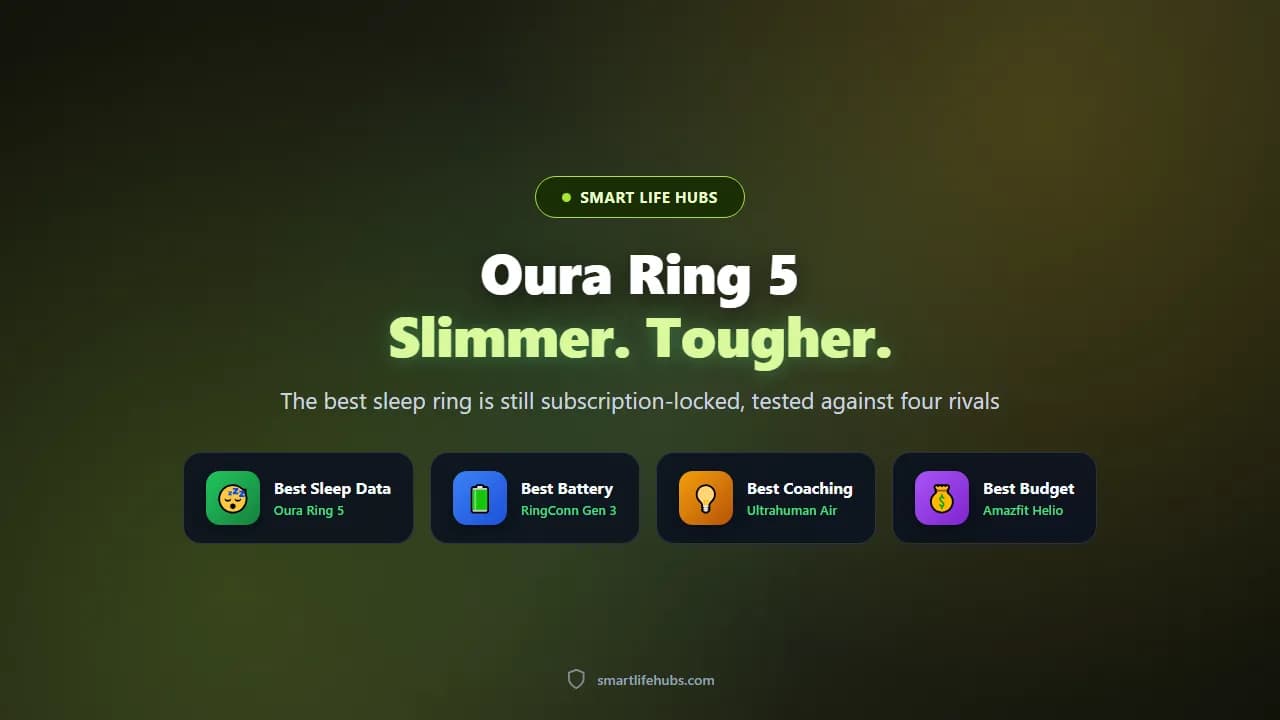
| Oura Ring 5 | Best overall: deepest sleep data | 6.09mm wide, 2 to 2.69g, 6-9 day battery, 100m IP68, Health Radar | $399 to $499 | $615 to $715 with membership |
| RingConn Gen 3 | Best battery, no subscription | Titanium, 11-14 day battery, charging case, sleep apnea patterns | $349 to $369 | $349 to $369 |
| Ultrahuman Ring Air | Best coaching, no subscription | 2.4g, 4-6 day battery, circadian and caffeine guidance, 100m | $349 | $349 |
| Samsung Galaxy Ring | Best for Samsung phone owners | 2.3g, 7 day battery, charging case, Energy Score, Android only | $299.99 | $299.99 |
| Amazfit Helio Ring | Best budget, no subscription | 4-7 day battery, EDA stress sensor, three sizes, Zepp app | $149.99 | $149.99 |
The best smart rings of 2026
1. Oura Ring 5, best overall
The Ring 5 is the most complete smart ring on the market, and the gap is in the app rather than the hardware. It tracks heart rate, HRV, respiratory rate, blood oxygen, and skin temperature around the clock, then turns those signals into Readiness, Sleep, and Activity scores each morning. Sleep is where it earns its price. It captures brief wake-ups that wrist trackers smooth over, gives you a sleep score with a stage breakdown, and adds sleep debt tracking plus a body clock feature that estimates your optimal sleep window from your chronotype and compares it against when you actually go to bed. The new Health Radar reads blood pressure signals and nighttime breathing patterns, and the app now covers cardiovascular age, cardio capacity, and metabolic health. Battery runs 6 to 9 days depending on ring size, because smaller rings carry smaller batteries, and a full charge takes about 80 minutes on the included dock. The optional charging case costs $99 and returns a full day in 10 minutes. The ring is rated to 100 metres and survives showers, swimming, and saunas. The catch is the membership. Without it you get the three daily scores, battery level, and settings, but none of the trends. With it, you pay $5.99 a month or $69.99 a year for the data you already bought the hardware to collect. Over three years that is $615 to $715 for the ring and the app, which is more than a premium smartwatch.
- Pros: Best sleep tracking in the category; Health Radar blood pressure and breathing signals; 2 to 2.69g and 100m water resistance
- Cons: Membership required for the useful features; 3 days of onboard storage; $615 to $715 over three years
Check today’s price on Amazon.
2. RingConn Gen 3, best battery and no subscription
The Gen 3 is the ring I recommend to anyone who wants Oura-level data without a monthly bill. It is titanium, lasts 11 to 14 days on a charge with vibration alerts off and 10 to 12 days with them on, and the included wireless charging case holds over 150 days of backup power. It tracks sleep stages, HRV, blood oxygen, skin temperature, stress, and steps, and it adds vascular trend insights and sleep apnea pattern detection that work without a subscription. At 2.3 millimetres thick and 2.5 to 3.5 grams depending on size, it is slim enough to forget. The weaknesses are automatic workout detection, which is unreliable, and an app that is functional rather than polished. With no recurring fee and a street price around $350, it is the best value for a buyer who plans to keep the ring for years.
- Pros: 11-14 day battery with a 150-day charging case; vascular trends and sleep apnea patterns free; no subscription
- Cons: Automatic workout detection is unreliable; app UX lags behind Oura and Ultrahuman
Check today’s price on Amazon.
3. Ultrahuman Ring Air, best coaching without a subscription
The Ring Air is the lightest ring here at 2.4 grams, and it is the only one that tells you when to stop drinking coffee. Its circadian rhythm feature suggests your optimal caffeine window from your sleep data, and the Movement Index nudges you to break up long sitting stretches. It tracks sleep, HRV, SpO2, skin temperature, stress, and over 100 workout modes, and it syncs with Apple Health and Google Health Connect. Battery is the weak point at 4 to 6 days in Turbo Mode and up to 8 in Chill Mode. Optional PowerPlugs add deeper insights from $24 a year, but the core experience is complete without them. At $349 with no required subscription, it is the best pick if you want proactive guidance rather than a dashboard of scores.
- Pros: Lightest at 2.4g; circadian and caffeine coaching; Apple Health and Health Connect sync; no subscription required
- Cons: 4-6 day battery needs twice-weekly charging; optional PowerPlugs for deeper insights
Check today’s price on Amazon.
4. Samsung Galaxy Ring, best for Samsung owners
If your phone is a Galaxy, this is the ring that fits your life with the least friction. The Energy Score folds into Samsung Health alongside your Galaxy Watch data, the double-pinch gesture dismisses alarms, and Find My Ring locates the ring if you take it off at the gym. Battery is a genuine 7 days, the included charging case holds about 1.5 extra charges, and at 2.3 grams for the smallest size it is the lightest premium ring here. Samsung cut the price from $399.99 to $299.99 on its US store in 2026, which makes it the cheapest major-brand ring with no subscription. The limitation is hard: no iPhone support, and the best features only work on Samsung phones. If you carry an iPhone or a non-Samsung Android, skip it.
- Pros: 7-day battery with charging case; $299.99 with no subscription; tight Galaxy Watch integration
- Cons: Android only, best features locked to Samsung phones; no iPhone support at all
Check today’s price on Amazon.
5. Amazfit Helio Ring, best budget
Amazfit cut the Helio Ring to $149.99 and made all software free for life, including the Zepp Aura Premium tier that used to cost extra. It tracks sleep stages, HRV, blood oxygen, skin temperature, stress, and readiness, and the unusual sensor is EDA, which measures skin conductance for a more detailed stress picture than HRV alone. Battery runs 4 days at typical polling and up to 7 if you reduce heart rate sampling. The catch is sizing: the Helio comes in only three sizes, so if your finger is not one of them, this ring does not exist for you. The Zepp app is functional but less polished than Oura’s, and sleep staging is less validated in independent comparisons. If you already own an Amazfit watch, the data merges into one profile rather than competing. For $150 it is the cheapest way into a serious smart ring.
- Pros: $149.99 with all features free; EDA stress sensor; merges with Amazfit watch data
- Cons: Only three sizes; sleep staging less validated than premium rings; basic app
Check today’s price on Amazon.
How to choose a smart ring
Decide whether you can tolerate a subscription. The Ring 5 costs $399 plus $5.99 a month. Every other ring here costs $149.99 to $349 once and nothing more. Over three years the Oura totals $615 to $715, while the RingConn Gen 3 totals $349 and the Amazfit Helio Ring totals $149.99. If a monthly health bill bothers you, the subscription-free options deliver the same core sleep, heart rate, and HRV data for a fraction of the cost. For the widest look at those options, our no-subscription smart ring roundup covers six of them.
Battery life decides whether you actually wear it. A ring you charge every three days becomes a ring you leave on the charger. The RingConn Gen 3 at 11 to 14 days, the Oura Ring 5 at 6 to 9 days, and the Samsung Galaxy Ring at 7 days are the ones you will keep on through a two-week trip. The Ultrahuman at 4 to 6 days and the Amazfit at 4 to 7 days need a charging habit. If you hate plugging things in, battery is the first filter, and the RingConn wins.
Sizing is the silent dealbreaker. The Amazfit Helio comes in three sizes. If your finger is not one of them, you cannot buy it. The Ring 5 comes in sizes 6 to 13 and Oura says the sizing differs slightly from the Ring 4, so order the sizing kit and wear it for a day. A ring that is too loose rotates and corrupts the readings; too tight and it restricts blood flow, which also ruins the data. Order the kit, test it for 24 hours, and confirm before you commit.
Match the app to the question you are asking. If sleep architecture and long-term trends matter most, the Ring 5 has no rival. If you want coaching that changes your day, the Ultrahuman Ring Air tells you when to caffeinate and when to move. If you want the most data for the least money, the RingConn Gen 3 gives you vascular trends and sleep apnea patterns for free. If you want your ring and watch in one place, the Samsung and Amazfit rings win for their own ecosystems. If you are choosing between the Ring 5 and a wrist tracker, our Fitbit Air vs Oura Ring 5 comparison covers that trade-off directly.
Check water rating and onboard storage. Every ring here is rated to at least 50 metres, and the Oura, RingConn, and Ultrahuman reach 100 metres, so swimming is safe across the board. Onboard storage differs more: the Ring 5 keeps three days of data, while the Fitbit Air keeps a week. If you regularly leave your phone behind for days, more storage means fewer gaps in your history.
Frequently asked questions
Frequently Asked Questions
6Yes, if sleep is the metric you care about most. It tracks sleep stages more faithfully than any wrist tracker, adds sleep debt and body clock insights, and includes Health Radar blood pressure and breathing signals. It is hard to justify if you only want steps and heart rate, because the Amazfit Helio Ring covers those for $149.99 with no subscription.
You need it for the useful features. Without membership the app shows three daily scores, battery level, profile, settings, and Explore, but not sleep trends, readiness breakdowns, or long-term insights. Membership costs $5.99 a month or $69.99 a year, and new rings include one free month.
The RingConn Gen 3, at 11 to 14 days per charge with vibration alerts off and a charging case that holds over 150 days of backup power. The Oura Ring 5 runs 6 to 9 days depending on ring size, the Samsung Galaxy Ring runs 7 days, and the Amazfit Helio Ring runs 4 to 7 days.
Most rings are not designed for heavy lifting, climbing, or grappling. A metal ring on a gripping finger is a hazard with a barbell and a distraction on a pull-up bar. If you lift heavy, a wrist tracker such as the Fitbit Edge or a screenless band is the safer tool, and you can keep the ring for sleep and daily wear.
Most do. The Oura Ring 5, RingConn Gen 3, Ultrahuman Ring Air, and Amazfit Helio Ring all work with iOS, and Oura and Ultrahuman sync with Apple Health. The Samsung Galaxy Ring is Android-only and its best features need a Samsung phone, so iPhone owners should skip it.
For resting heart rate, overnight HRV, and sleep staging, rings generally match or beat wrist trackers because the finger has strong peripheral blood flow and less motion artifact at night. For exercise heart rate during intervals, wrist and arm sensors usually do better. Wired’s smart ring roundup reaches the same conclusion across its tested models.
The bottom line
Buy the Oura Ring 5 if sleep is the data you would pay to perfect: it is the smallest and most polished ring here, the sleep tracking is the best available, and Health Radar adds signals no rival offers, at the cost of $399 plus $69.99 a year. Buy the RingConn Gen 3 if you want the same core data with a two-week battery and no subscription. Buy the Ultrahuman Ring Air if you want coaching that tells you when to caffeinate and when to move. Buy the Samsung Galaxy Ring if you own a Galaxy phone and want the tightest integration for $299.99. Buy the Amazfit Helio Ring if $149.99 is your ceiling and your finger is one of its three sizes. For most people who simply want better sleep data, the Ring 5 is still the one to beat, and the membership is the price of admission. Which ring would you choose? Tell us in the comments.