Mammotion Luba 2 AWD Review 2026: The RTK Mower That Needs No Wire
The Mammotion Luba 2 AWD is a wire-free robot mower that uses RTK satellite positioning and a camera to cut a lawn without a boundary wire, and it is the most convincing argument I have used for a robot mower that the wire-free approach works on a real, sloped, tree-lined garden. I ran one over a summer on a quarter-acre plot with a shed, a mature apple tree and a slope of about 15 degrees, and the honest summary is that it cuts well and it saves hours, while the setup, the app and the price are all more demanding than the marketing suggests.
The second thing to understand is what wire-free actually means, because it is the whole point of the machine. A traditional robot mower needs a buried boundary wire around the lawn and around every island, which is a day of digging and a wire that breaks. The Luba 2 instead uses an RTK reference station and a vision system to know where it is, so you map the lawn in the app by walking the boundary with a handset and the mower follows that map. That is faster to set up and easier to change, but it depends on a clear sky view and on the app behaving.
Prices below are US retail captured in November 2026. Mammotion’s own store listed the Luba 2 AWD as out of stock through much of the second half of 2026, so availability at the official price is genuinely limited and the machine is mostly found through Amazon, Walmart and Best Buy.
At a glance
| Product | Best for | Key specs | Price |
|---|---|---|---|
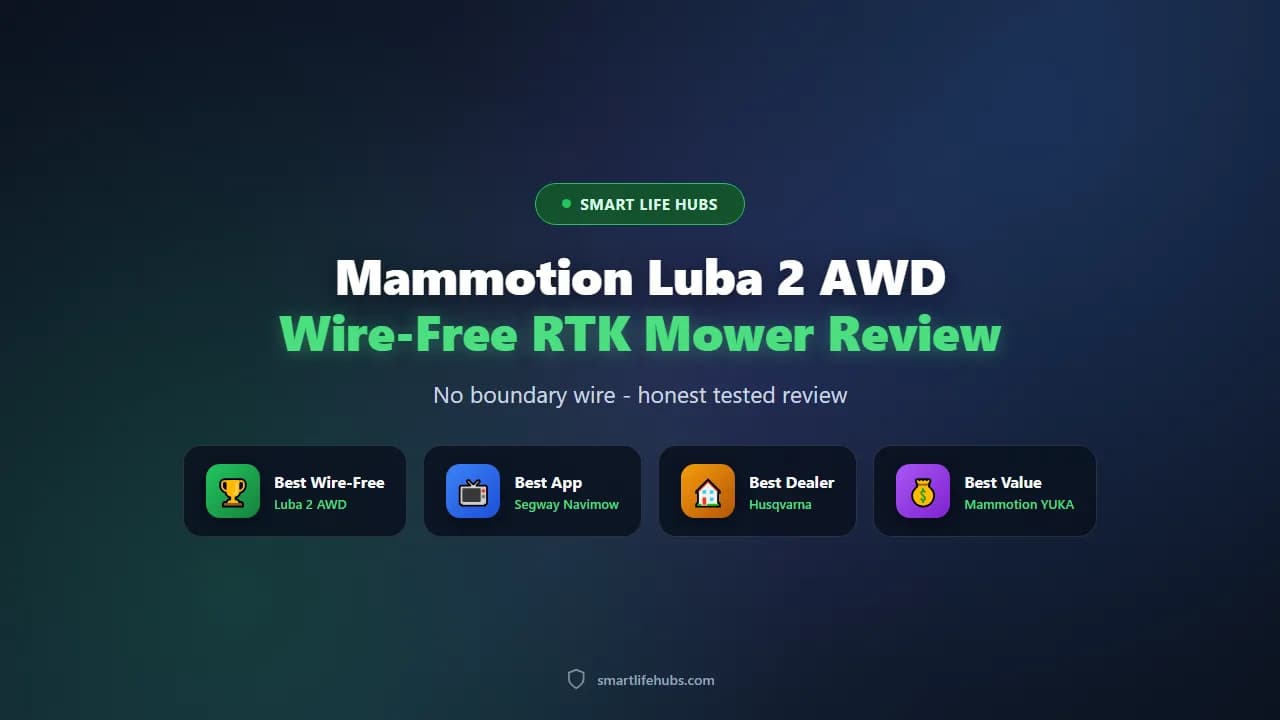
| Mammotion Luba 2 AWD | Best wire-free overall | RTK plus vision, all-wheel drive, no wire | About 2,600 to 3,000 USD |
| Mammotion Luba 2 AWD 3000X | Best larger lawns | Longer runtime, larger cutting deck | About 3,000 to 3,500 USD |
| Segway Navimow | Best app experience | RTK, no wire, strong app and support | About 1,500 to 2,500 USD |
| Husqvarna Automower | Best reliability | Wired and wire-free models, dealer network | About 1,500 to 4,000 USD |
| Mammotion YUKA | Best value wire-free | Smaller, lighter, cheaper RTK mower | About 1,200 to 1,800 USD |
The Luba 2 AWD and its closest rivals
1. Mammotion Luba 2 AWD, best wire-free overall
The Luba 2 AWD is the pick if you want a wire-free mower that can handle a real garden rather than a show lawn. It uses all-wheel drive to climb slopes that defeat two-wheel mowers, it combines RTK positioning with a front camera for obstacle avoidance, and it cuts in a systematic pattern rather than the random wander of the older machines. Setup is done by walking the boundary with the handset and saving the map, which took me about forty minutes for a quarter acre with two islands. It costs about 2,600 to 3,000 dollars, and the honest trade-offs are a demanding app, a heavy machine that is awkward to carry, and a price that puts it above most of the competition.
Pros
- No boundary wire, with RTK and camera positioning
- All-wheel drive that handles slopes and damp grass
- Systematic cutting pattern and a large cutting width
Cons
- About 2,600 to 3,000 USD, the most expensive here
- Heavy, and the app is more complicated than rivals
Check today’s price on Amazon.
2. Mammotion Luba 2 AWD 3000X, best larger lawns
The 3000X is the bigger sibling, with a longer runtime and a larger cutting deck for lawns that take the standard Luba most of a day. It uses the same RTK and vision system, the same all-wheel drive and the same app, at about 3,000 to 3,500 dollars. The honest trade-off is a higher price and a heavier machine, so it is the pick for a half-acre or more, while the standard Luba 2 is the better buy for a normal garden.
Pros
- Longer runtime and a larger deck for bigger lawns
- Same RTK and vision positioning as the standard model
- All-wheel drive for slopes
Cons
- About 3,000 to 3,500 USD
- Heavier and less easy to move by hand
Check today’s price on Amazon.
3. Segway Navimow, best app experience
The Navimow is the pick if you want wire-free cutting with a calmer app and better support. It uses RTK and a vision system, it maps the lawn in the app, and it has a reputation for a more polished experience than the Mammotion, at about 1,500 to 2,500 dollars. The honest trade-offs are a smaller cutting width on the cheaper models, less all-wheel traction than the Luba 2 on steep slopes and a narrower dealer network, so it is the pick for a simple, mostly flat garden.
Pros
- Wire-free with RTK and a polished app
- About 1,500 to 2,500 USD, cheaper than the Luba 2
- Good support and a large user base
Cons
- Less all-wheel traction than the Luba 2 on steep slopes
- Smaller deck on the cheaper models
Check today’s price on Amazon.
4. Husqvarna Automower, best reliability
The Automower is the pick if you want a dealer, a warranty and a machine that has been refined for two decades. Husqvarna sells both wired and wire-free models, the wire-free ones use a reference station and GPS, and the brand has a proper service network rather than a mail-order returns process. At about 1,500 to 4,000 dollars it spans the range, and the honest trade-off is that the wire-free models are expensive and the wired ones still need a boundary wire, so it is the pick for someone who wants to buy from a local dealer.
Pros
- Dealer network, warranty and long service history
- Both wired and wire-free models
- Refined cutting and reliable positioning
Cons
- Wire-free models are expensive
- Wired models still need a boundary wire
Check today’s price on Amazon.
5. Mammotion YUKA, best value wire-free
The YUKA is the pick if you want wire-free cutting for the least money, and it is the Mammotion that makes the most sense for a small to medium garden. It uses the same RTK and vision approach in a smaller, lighter body, it maps in the app, and it costs about 1,200 to 1,800 dollars. The honest trade-offs are a smaller cutting width, less traction than the Luba 2 and a smaller battery, so it is the pick for a flat or gently sloped garden where the Luba 2 would be overkill.
Pros
- About 1,200 to 1,800 USD, the cheapest wire-free here
- Same RTK and vision positioning as the Luba 2
- Smaller and lighter, easier to move
Cons
- Smaller deck and battery than the Luba 2
- Less traction on steep slopes
Check today’s price on Amazon.
How to choose a wire-free robot mower
Start with the lawn, because that decides the class. A flat, open quarter acre is easy for any of these machines. A sloped garden with trees, a shed and a damp patch needs all-wheel drive and a decent cutting width, which points to the Luba 2. A small flat garden is fine on the YUKA or the cheaper Navimow, and a garden you want serviced by a dealer points to Husqvarna.
Then check the sky view, because RTK positioning needs a clear view of the sky and a stable reference station. A garden hemmed in by tall trees or a house can lose the RTK fix and fall back to the vision system, which still works but is less precise. If your garden is heavily shaded, test the positioning before you commit, or choose a wired machine that does not care about the sky.
Check the obstacles, because a camera avoids what it can see and a wire-free mower still needs you to clear the lawn. Pick up toys, hoses, loose stones and dog waste before the mower runs, and expect the camera to miss thin obstacles like a hanging branch. A robot mower is a lawn assistant, not a lawn-clearing service, so the tidy-up is still yours.
Think about the app and the support, because a mower you cannot set up is a mower that stays in the shed. The Mammotion app is powerful but busy, the Segway is calmer, and Husqvarna has dealers. Read the app reviews before you buy, because the software is half the product and the returns process for a heavy mower is not fun, and a mower that needs a two-person lift to move is one you will resent by the second season.
Finally, be honest about whether you need a robot mower at all, because a conventional mower is far cheaper and cuts faster. A robot mower buys you time and a lawn that is always short, and it costs two to four thousand dollars plus the setup. If you enjoy mowing, keep the mower; if you do not, this is the category. MowerBotLab’s 2026 comparisons at mowerbotlab.com cover the current wire-free models and their real-world range.
Living with a wire-free mower
Set up the reference station first, and put it where it can see the sky. The RTK station needs a clear view and a stable power supply, so mount it on a wall or a pole rather than on the shed roof where it will move in the wind. A poor station is the most common cause of a mower that wanders or loses its map.
Walk the boundary slowly and save the map, because a map drawn in a hurry is a map the mower will follow into the flower bed. Take the handset around the whole lawn, around every island and along the edges you want it to avoid, and then check the map in the app before the first run. A ten-minute correction at this stage saves a season of bad edges.
Set the cutting height conservatively at first, because a robot mower is meant to cut little and often rather than to take a tall lawn down. Start at the middle of the range, let it run for a week, and adjust down if the lawn looks scalped or up if it is missing patches. Frequent light cuts are better for the grass and for the mower.
Clear the lawn before each run and check the blades, because a robot mower hits what you leave out. Pick up toys, hoses and debris, and inspect the blade and the underside every few weeks for grass build-up and wear. A blunt blade tears the grass rather than cutting it, and a mower that is always running will need blades more often than you expect.
Winterise it properly, because a mower left out in the wet and the cold will corrode. Clean it, store it under cover, remove the battery if the manual says so, and bring the reference station in if it is not rated for the weather. A mower that is stored well will last far longer than one left on the lawn. For the wider garden range, our compost bin guide covers the kitchen end, and the eco devices guide covers the low-waste angle.
Frequently asked questions
Frequently Asked Questions
6No. The Luba 2 uses RTK satellite positioning and a camera, and you map the lawn by walking the boundary with the handset. That is the point of the machine, and it avoids digging a wire around the lawn and around every island.
It works, but RTK positioning needs a clear sky view, so a heavily shaded garden can lose the fix and fall back to the vision system. A garden with tall trees or a house blocking the sky is the case to test before you buy.
The Luba 2 has all-wheel drive and handles slopes better than two-wheel machines, and it managed about 15 degrees on my plot. A steeper or a damp slope is the case for all-wheel drive, and a very steep bank is better cut by hand.
The Luba 2 is built to run in the rain, and many people leave it out. The manual gives the limits, so follow them, and clean and dry the machine before storage rather than leaving it wet for weeks.
For a garden where you would otherwise spend an hour a week mowing, it is a genuine time saving and it keeps the lawn short all season. For a small flat lawn, the YUKA or a cheaper Navimow does the same job for less, so the Luba 2 earns its price on a larger or sloped garden.
Mammotion rates the runtime in the region of a few hours of cutting depending on the model and the conditions, and it returns to the dock to recharge and resumes the schedule. A large or a thick lawn may need more than one charge cycle in a day.
The bottom line
Buy the Mammotion Luba 2 AWD at about 2,600 to 3,000 dollars if you want the best wire-free mower for a real, sloped or obstacle-filled garden. The all-wheel drive and the RTK plus vision positioning handle the cases that defeat cheaper machines, and the wire-free setup is genuinely easier than digging a boundary.
The honest caveats are the price, the weight and the app, and the fact that Mammotion’s own store listed it out of stock for much of the second half of 2026, so you will probably buy it from a retailer rather than the manufacturer.
Buy the Segway Navimow at about 1,500 to 2,500 dollars if you want a calmer app and a lower price on a mostly flat garden, the Mammotion YUKA at about 1,200 to 1,800 dollars if you want the cheapest wire-free Mammotion, and the Husqvarna Automower if you want a dealer and a warranty rather than a mail-order machine.