Dexcom Stelo Review 2026: The First OTC CGM for Biohackers
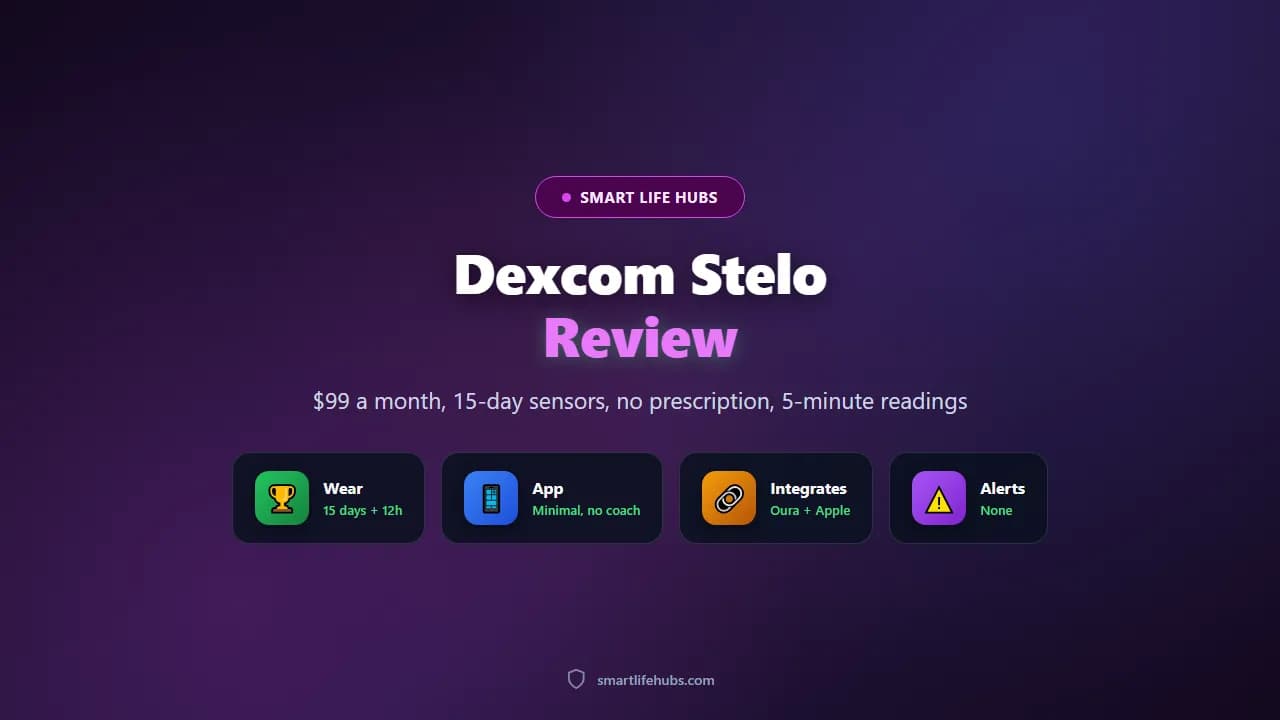
The Dexcom Stelo is the first continuous glucose monitor you can buy without a prescription, and it remains the best one for most people who do not have diabetes. It costs $99 for a two-sensor pack, or $89 a month on subscription, and each sensor lasts 15 days with a 12-hour grace period, so two sensors cover a full month. It sends a reading every five minutes to the Stelo app over Bluetooth, stores 90 days of history, and feeds glucose into Apple Health, Google Fit and the Oura app, which is where the real value appears.
It is a sensor and a very simple app, and nothing more. There is no meal scoring, no coaching, no education layer and no CSV export, and Dexcom has not published a Stelo-specific accuracy figure. If you want interpretation, you buy a coaching programme or a separate app. If you want the raw data with the longest wear time and the best integrations in the category, this is the one.
I pulled BetterVitals’ and Tested Intelligence’s reviews, Optimize Biomarkers’ pricing breakdown, the FDA’s clearance notices, and Dexcom’s published specifications. Where a figure is a claim rather than a measurement, I say so. Prices are as of November 2026.
At a glance
| Product | Best for | Key specs | Price |
|---|---|---|---|
| Dexcom Stelo | Best overall OTC CGM | 15-day sensor, 5-minute readings, Oura and Apple Health sync, no subscription | $89 to $99 a month |
| Abbott Lingo | Best value | 14-day sensor, Lingo Count score, no prescription | $54 one sensor, $89 two, $249 six |
| Nutrisense | Best coached programme | Two sensors a month, dietitian access | $152 to $212 a month |
| Signos | Best for weight loss | Two sensors a month, AI app, dietitian chat | $169 to $299 a month |
| Levels | Best for analytics | Membership app, lab panels, Stelo sensors as add-on | $15 a month app, Core $399 a year |
Dexcom Stelo in detail
Hardware and application
The sensor is small: 24.14 millimetres wide, 27.4 long and 4.72 high, a flexible wire inserted under the skin by a spring-loaded applicator and connected to a transmitter that sits under a patch and an overpatch. Application is a single press, and it is noticeably less fiddly than the applicators on older Dexcom hardware. The warm-up is 30 minutes, and from then on the sensor sends a reading every five minutes for up to 15 days, with a 12-hour grace period after the session ends. A two-sensor pack therefore covers about 30 days.
The hardware is water resistant to 8 feet for up to 24 hours when applied properly, which means you can shower and swim with it. Dexcom notes that readings may not arrive until you are out of the water, because water blocks the Bluetooth signal. That is normal for every CGM and not a fault.
What the app does, and what it does not
The Stelo app is deliberately minimal, and that is either its strength or its weakness. You get a glucose curve, time-in-range statistics, a steady indicator, event logging, a weekly spike report and a trend arrow. A newer update added Smart Food Logging with a database of more than a million foods, text search, barcode scanning and photo logging, which ties what you eat to how your glucose responds. The app holds 90 days of history and can share readings with a clinician.
What you do not get is meal scoring, a dietitian, an education layer or coaching. There is no food-logging integration beyond the built-in logger, and there is no consumer API or CSV export, so you cannot pull your raw data into a spreadsheet the way you can with a prescription Dexcom account. If you want interpretation, you either pay for a programme or accept that you are reading the graph yourself.
Accuracy and the honest limits
Dexcom has not published a Stelo-specific MARD, and the FDA said only that it performed similarly to other integrated continuous glucose monitors. Third-party estimates put it at roughly 8 to 10 percent, and the same glucose oxidase technology in the prescription G7 measured about 8.2 percent on the arm in the study Dexcom submitted for clearance. Abbott’s Lingo reports a marginally lower figure in its own submission data, so on paper the two are close.
The more useful caveat is the lag. Interstitial glucose trails blood glucose by 5 to 15 minutes, so the peak you see after a meal arrives late and smoothed, and reviewers note occasional erratic readings in the first day of wear and overnight. Treat the curve as the product, not any single number. For spotting which meals spike you and watching a trend over weeks, that accuracy is more than enough.
Who can use it, and who cannot
The Stelo is cleared for anyone aged two and over who does not use insulin, following the FDA’s June 2026 extension to children, with an adult caregiver supervising. It is explicitly not for people with problematic hypoglycaemia, because the device is not designed to alert you to a dangerous low, and the display gives no glucose alerts at all. It is also not for people on dialysis, and the FDA advises anyone with a history of disordered eating to talk to a healthcare provider first.
Those limits are not fine print to skim. A device with no low alert is a genuine safety difference from a prescription CGM, and it is the reason this belongs to well people rather than anyone managing a condition.
The integrations, which are the point
The strongest reason to choose the Stelo over a cheaper sensor is what happens to the data. Glucose flows into Apple Health, Google Fit and the Oura app, and in Oura you can overlay the glucose curve on your sleep score, heart rate variability and daily activity. That overlay is where a CGM stops being a curiosity and starts being useful, because it lets you see that a bad night raises your next-day baseline, or that a walk after dinner flattens a spike.
BetterVitals’ Stelo review reached the same conclusion, calling it the best over-the-counter CGM for 2026 on the strength of the wear time and the integrations while noting the spartan app. One limitation worth knowing: Levels does not natively integrate with Stelo, so if the Levels analytics layer is what you want, the sensor alone will not feed it.
The cost, worked out properly
The one-time two-pack is $99, which is about $3.30 a day. The monthly subscription is $89, about $2.97 a day, and a three-month subscription brings it to roughly $82 a month or $2.73 a day. A single sensor is $49.99. There is no subscription commitment, so you can buy one box, learn for a month and stop, which is the sensible way to try it.
Against the alternatives, the Stelo is more expensive than the Abbott Lingo on a like-for-like month, and cheaper than every coaching programme. What you are paying for is the 15-day wear, the five-minute reading interval and the ecosystem, not a better number.
The honest drawbacks
The app is the first weakness, and it is a real one. If you have never looked at a glucose curve, the Stelo gives you the data with no guidance on what to do about it. The second is the accuracy variance in the first day and overnight, which is common to all CGMs but still worth knowing before you panic at a strange reading. The third is the lack of alerts, which rules it out for some people entirely. The fourth is the recurring cost: at $89 a month the sensors are consumables, and skipping a month means your data stops.
There is also the question of whether you need it. If you only want to know whether a food spikes you, a two-week Lingo trial at $49 answers that for a fifth of the price. The Stelo earns its place if you want to keep the data long term and see it alongside your sleep and recovery.
How it compares
The Abbott Lingo is $54 for a single 14-day sensor and $89 for two, with a beginner-friendly Lingo Count score instead of raw numbers, and it is the better choice for a first experiment. Nutrisense at $152 to $212 a month and Signos at $169 to $299 a month bundle the same Stelo hardware with dietitian support, so they suit people who want interpretation rather than data. Levels charges $15 a month for its analytics app with sensors bought separately, and it is the deepest analysis layer if you want lab panels and long trend history, though it does not integrate natively with Stelo. The prescription Dexcom G7 and FreeStyle Libre 3 require a prescription and are usually covered by insurance for people with diabetes.
Is the Dexcom Stelo worth $99 a month?
Buy it if you want the best integrations. If you already use an Oura ring or live in Apple Health, having glucose overlaid on your sleep and HRV data is the most useful thing a CGM can do, and the Stelo is the only over-the-counter sensor that does it well.
Buy it if you want the longest wear. Fifteen days per sensor is a day more than Lingo, and the 30-minute warm-up is short, so you spend less time swapping and waiting.
Buy it if you want to stop after a month. There is no subscription commitment, so you can buy the $99 two-pack, learn what you need and walk away. That is the single biggest advantage over the coaching programmes.
Buy the Abbott Lingo if you want the cheapest experiment. At $49.99 for a single 14-day sensor, it is the lowest-risk way to find out whether you will use the data.
Buy a coaching programme if you want interpretation. If the graph alone will not change what you eat, Nutrisense or Signos will give you a person to work with, at three times the price.
Do not buy it if you need alerts. The Stelo gives no glucose alerts at all, so it is not a substitute for a prescription CGM if you need to know about a low.
Think about the app on your phone. The Stelo needs a recent iPhone or Android phone running a current operating system, and it is the only interface for your data. There is no web dashboard, so if you prefer reviewing trends on a laptop you will be pinching and zooming on a phone screen.
Think about the rest of the health stack. Our CGM roundup covers the alternatives, and our sleep gadget guide covers the recovery data you would overlay it with.
Frequently asked questions
Frequently Asked Questions
6A one-time two-sensor pack is $99, a monthly subscription is $89 a month, a three-month subscription is about $82 a month, and a single sensor is $49.99. Each sensor lasts 15 days plus a 12-hour grace period.
No. It was the first over-the-counter CGM the FDA cleared, for people aged two and over who do not use insulin.
Dexcom has not published a Stelo-specific MARD. The FDA said it performed similarly to other integrated CGMs, and third-party estimates put it around 8 to 10 percent. Interstitial readings lag blood glucose by 5 to 15 minutes.
Yes. Glucose flows into Apple Health, Google Fit and the Oura app, and Oura lets you overlay the glucose curve on sleep, heart rate variability and activity data.
No. The FDA says the system is not designed to alert users to problematic hypoglycaemia, and the display gives no glucose alerts. It is not for people on insulin or with problematic low blood sugar.
Yes, if you want the longest wear time, the best integrations and the freedom to stop after a month. It is harder to justify if you only want to test one or two foods, because a Lingo trial costs a fraction of the price.
The bottom line
The Dexcom Stelo is the best over-the-counter continuous glucose monitor you can buy. You get a 15-day sensor with a 30-minute warm-up and readings every five minutes, 90 days of history, a minimal app with food logging, and glucose in Apple Health, Google Fit and Oura, for $99 a two-pack or $89 a month with no commitment. The weaknesses are the app, which offers no coaching or meal scoring, the absence of any alerts, occasional erratic readings in the first day and overnight, and the recurring cost. Buy it if you want the integrations and the freedom to stop. Buy the Abbott Lingo if you want the cheapest experiment, or a coaching programme if you want a person to interpret the data. Have you tried a CGM? Tell us in the comments.