Best Weighted Vests of 2026 for Rucking (5.11 vs Hyperwear vs Budget)
Rucking is walking with weight on your back, and the vest is the piece of kit that makes it work or makes it miserable. A good rucking vest holds the load close to your body, spreads it across your shoulders and back, and does not bounce or chafe over miles. A bad one does all three wrong, and you will feel it by mile three. The category splits into purpose-built rucking vests, low-profile stretch vests for lighter loads, plate carriers borrowed from tactical gear, and cheap adjustable vests that do the job for a fraction of the price.
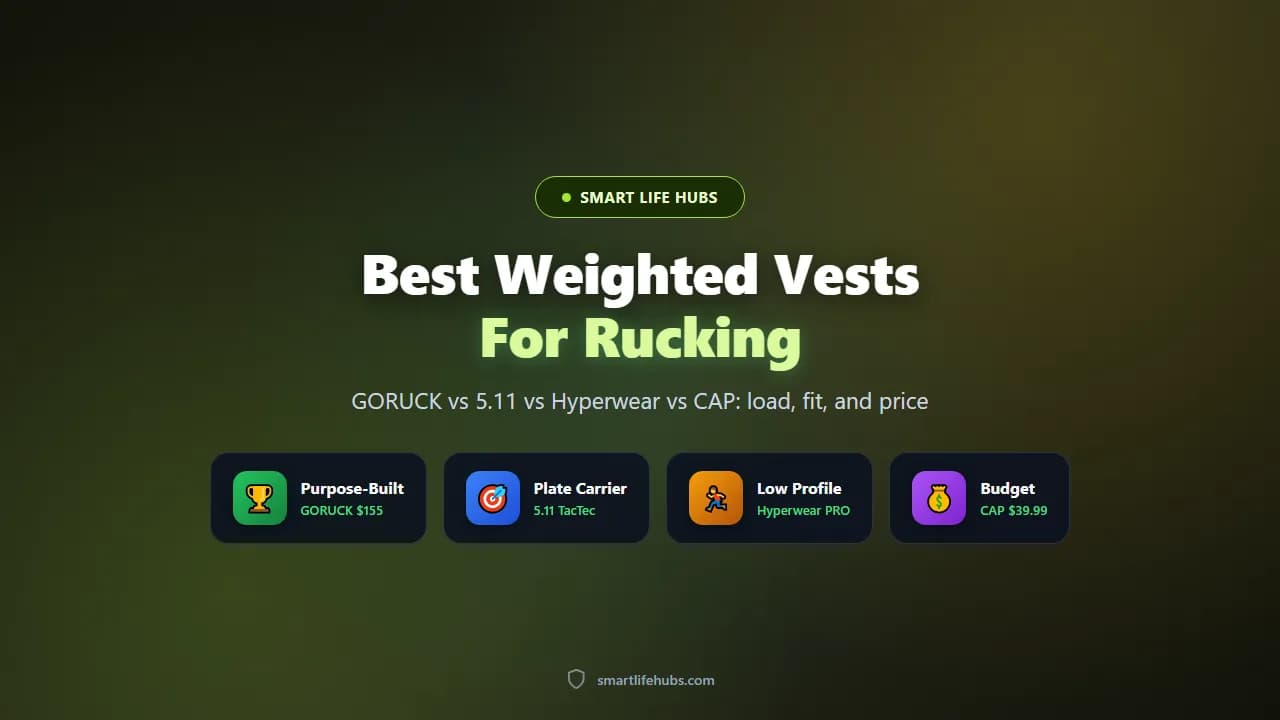
Prices run from about $26 for a basic adjustable vest to $250 for a tactical plate carrier, with purpose-built rucking vests around $150 to $195. The GORUCK Rucking Weighted Vest at $155 is the best choice if you want a vest designed for exactly this, the Hyperwear Hyper Vest PRO at $239.95 is the best if you want a low-profile vest for lighter rucks and running, and the CAP Barbell at $39.99 is the best budget option.
I pulled Outdoor Gear Lab’s and Ruck Authority’s tested comparisons, Home Gym Verdict’s and Compare Elite’s rankings, and the manufacturers’ specifications. Where a figure is a claim rather than a measurement, I say so. Prices are US street prices as of November 2026.
At a glance
| Product | Best for | Key specs | Price |
|---|---|---|---|
| GORUCK Rucking Weighted Vest | Best purpose-built | Curved ruck plates sold separately, 10 to 60 lb, padded shoulders | $155 plus plates |
| Hyperwear Hyper Vest PRO | Best low-profile | Stretch fabric, 2.25 oz micro-weights, 10 lb up to 40 lb by size | $239.95 to $409.95 |
| 5.11 Tactical TacTec | Best plate carrier | Plate carrier with front and back load, 500D nylon | About $150 to $250 plus plates |
| GORUCK Achilles | Best fixed heavy load | Fixed 20 or 30 lb, quick setup, ballistic nylon | $195 |
| CAP Barbell Adjustable | Best budget | 20 to 40 lb in steel-shot packets, one size with clips | $39.99 |
The best weighted vests for rucking of 2026
1. GORUCK Rucking Weighted Vest, best purpose-built
The GORUCK Rucking Weighted Vest costs $155 and it is the vest designed for this exact activity, which shows. It takes GORUCK ruck plates front and back, so the load sits where a rucksack would sit rather than hanging off your chest, and the plates are curved to follow your torso. Outdoor Gear Lab named it the best weight vest for rucking, praising the padding and weight distribution and the absence of pressure points on the shoulders, while noting it inhibited range of motion on upper body exercises such as push-ups and pull-ups. It is available in 10, 20, 40 and 60 pound configurations, and the plates are sold separately.
The trade-offs are the cost of the plates on top of the vest, the bulk compared with a stretch vest, and the fact that it is a specialist tool rather than an all-round trainer. If rucking is your main use, this is the one.
- Pros: Purpose-built for rucking; front and back load like a pack; padded shoulders; $155 plus plates
- Cons: Plates sold separately; bulky; restricts upper body range of motion
Check today’s price on Amazon.
2. Hyperwear Hyper Vest PRO, best low-profile
The Hyperwear Hyper Vest PRO costs $239.95 for the 10 pound version and up to $409.95 at 30 pounds, and it is the vest for people who hate the feeling of wearing weight. It uses a two-way stretch fabric with no neoprene, and 2.25 ounce galvanised steel micro-weights distributed across the front and back panels, so the load sits close and does not bounce. Compare Elite rated it 9.2 out of 10 and Home Gym Verdict named it the best weighted vest overall for its snug, no-bounce fit. The horizontal stretch lets your chest expand normally, which matters when you are breathing hard.
The trade-offs are the price and the capacity cap, which is determined by size, running 20, 25, 30 or 40 pounds for small through extra large. Ruck Authority rated it lower for rucking specifically and noted it is not ideal for heavy ruck training. If you ruck with 10 to 20 pounds and also run and do HIIT, it is the most comfortable option here. If you want to go heavy, look at the plate carriers.
- Pros: No bounce; stretch fabric breathes; fine 2.25 oz increments; 10 lb to 40 lb by size
- Cons: Expensive; capacity limited by size; not ideal for heavy rucking
Check today’s price on Amazon.
3. 5.11 Tactical TacTec, best plate carrier
The 5.11 Tactical TacTec Plate Carrier costs about $150 to $250 depending on retailer and sale, and it is the vest that CrossFit boxes know by name. It is a proper plate carrier in 500D nylon with perforated mesh panels, a cummerbund that fits a 52 to 57 inch circumference, and front and back plate pockets, so you load it with standard steel plates the same way you would a barbell. It is the vest for Hero WODs, Murph and short heavy rucks, and the front-and-back load shape is closer to a rucksack than a pocket vest.
The trade-offs are the price once you add plates, which Home Gym Verdict put at about $120 for a pair of 8.75 pound plates, and the fact that it is a tactical garment rather than a fitness vest, so it is less comfortable for long steady rucks than the GORUCK. If you want one vest for heavy rucking and hard conditioning work, it is the crossover pick.
- Pros: Real plate carrier; front and back load; standard plates; 500D nylon
- Cons: Plates cost extra; less comfortable for long rucks; sizing is one-size-ish
Check today’s price on Amazon.
4. GORUCK Achilles, best fixed heavy load
The GORUCK Achilles costs $195 and it is the simplest way to ruck heavy without fiddling with plates. The weight is fixed at 20 or 30 pounds, sewn in, so you choose your load at purchase and then just put it on. Ruck Authority rated it 8.1 out of 10 and recommended it for people who already train at a set load and value quick setup over adjustability, noting it suits quick weighted walks at a familiar weight.
The trade-off is that you cannot change the load, so if you want to progress you buy another vest. For a runner or rucker who has settled on a weight and wants zero setup, that simplicity is the point.
- Pros: $195; fixed 20 or 30 lb; no setup; ballistic nylon
- Cons: Load not adjustable; you buy another vest to change weight
Check today’s price on Amazon.
5. CAP Barbell Adjustable, best budget
The CAP Barbell Adjustable Weighted Vest costs $39.99 for the 20 pound version and it is the best value in the category by a wide margin. It uses steel-shot packets you add and remove in roughly 0.75 pound increments to build up to 20 pounds, with a one-size body and adjustable clips, breathable mesh and neoprene padding. Outdoor Gear Lab rated it well for comfort and ease of use and poorly for features, which is the right summary: it works, it is cheap, and it is basic.
The trade-offs are the one-size fit, the bulk when fully loaded, and the fact that it is aimed at static exercise rather than running. For a beginner testing whether rucking suits them, or for a home gym, it is the sensible first purchase. If you plan to ruck regularly, upgrade later.
- Pros: $39.99; adjustable 20 lb; comfortable for the price; easy to fit
- Cons: One size; bulky when loaded; not ideal for running or long rucks
Check today’s price on Amazon.
Rucking technique and progression
The vest is only half of it, and most beginners get the other half wrong. Rucking is not hiking with weight and it is not running with weight. It is a steady walk at a pace you could hold a conversation at, with a shorter stride than normal and a slight forward lean from the ankles rather than the waist. Keep your shoulders back and your head up, because the weight will pull you into a slouch by mile two, and a slouch is where the back pain comes from.
Progression is where people get hurt. A reasonable approach is to start with 10 to 20 pounds and a distance you could walk comfortably without weight, then add distance for a few weeks before adding load. Once you are comfortable at a given weight, increase by no more than 10 percent at a time and drop back for a week if anything hurts. Rucking is a low-intensity activity done frequently, so the training effect comes from accumulating hours, not from one hard session.
Finally, think about the surface. Rucking on road or compact trail is far kinder on your joints than concrete, and a route with hills gives you a strength stimulus that flat ground does not. If you have the choice, start flat and add elevation later.
How to choose a rucking vest
Start with the load, not the vest. Most beginners overdo it. A common starting point is 10 to 20 pounds for someone of average build, progressing gradually over months rather than weeks. Rucking with too much weight too soon is the fastest route to knee, hip and back trouble.
Match the load position to the activity. A rucksack carries weight front and back, so a vest with plates in both positions mimics it. A pocket vest with all the weight on the chest feels different and is better for walking and HIIT than for long rucks. If rucking is the goal, prioritise front-and-back distribution.
Prioritise fit and padding over the weight range. A vest that chafes at mile two is useless however many pounds it holds. Check the shoulder padding, the waist closure and whether the vest rides up when you bend. Try it on with the intended load before committing, and check the return policy because fit is personal.
Decide adjustable or fixed. Adjustable vests let you progress and share the vest, and they cost more upfront. Fixed vests are simpler, often cheaper for a given weight and quicker to put on, but you buy another one to change load. If you are unsure, adjustable is the safer first buy.
Think about what else you will use it for. If the vest is only for rucking, the GORUCK is the specialist. If you also run, do HIIT or want something under a shirt, the Hyperwear stretch vest is more versatile. If you lift and want heavy carries, a plate carrier doubles as strength kit.
Do not neglect the basics. A good rucking vest will not fix poor footwear, a bad walking posture or a weekly mileage jump. Increase distance and weight separately, not together, and keep a day between hard rucks.
Think about the rest of the kit. Our hiking backpack guide covers carrying the load on your back, and our fitness tracker roundup covers tracking the effort.
Frequently asked questions
Frequently Asked Questions
6Start with 10 to 20 pounds for an average build and progress gradually. Increase distance and weight separately, and keep at least a day between hard rucks. More weight is not better if your form breaks down.
The GORUCK Rucking Weighted Vest at $155 plus plates, because it is designed for the activity and loads front and back like a rucksack. The GORUCK Achilles at $195 if you want a fixed 20 or 30 pounds with no setup, and the CAP Barbell at $39.99 if you are on a budget.
Yes, and it is the closest thing to a rucksack in load shape because the plates sit front and back. The 5.11 TacTec is the best known, but it is less comfortable over long steady miles than a purpose-built rucking vest.
Yes, with the right vest and a sensible load. The Hyperwear Hyper Vest PRO is the best here for running because its stretch fabric and micro-weights do not bounce. Pocket vests with heavy loads are poor for running and can chafe badly.
For walking and static exercise, yes. The CAP Barbell at $39.99 is comfortable for the price and adjustable, which makes it a good first vest. It is bulky when loaded and not well suited to running or long rucks.
Both work. A backpack is cheaper, carries more and is easier to load, but the weight sits lower and can pull on your shoulders differently. A vest keeps the load high and close, which suits shorter, faster rucks and double as conditioning kit.
The bottom line
Buy the GORUCK Rucking Weighted Vest if rucking is the point: $155 plus plates, a front-and-back load that mimics a rucksack and proper shoulder padding. Buy the Hyperwear Hyper Vest PRO if you want a low-profile vest for lighter rucks, running and HIIT at $239.95 to $409.95. Buy the 5.11 Tactical TacTec if you want a plate carrier that doubles for heavy conditioning at about $150 to $250 plus plates. Buy the GORUCK Achilles at $195 if you want a fixed 20 or 30 pounds with no setup, and the CAP Barbell at $39.99 if you are starting out. Outdoor Gear Lab’s tested weight vest comparison reached the same conclusion on the rucking category. The honest summary is that fit matters more than the weight range, and the vest you will actually wear beats the one with the biggest number on the label. Which one fits how you train? Tell us in the comments.