Best Smart Pet Feeders of 2026 (PetKit vs SureFeed vs WOpet)
Best smart pet feeders of 2026 fall into two genuinely different categories, and the mistake most people make is buying the wrong one. A timed feeder dispenses a measured portion on a schedule, which suits a normal feeding routine. A microchip feeder is a sealed bowl that opens only for the pet it recognises, which suits a house where one animal is on a prescription diet or one animal steals the other’s food. I have used both on a multi-cat household, and the honest finding is that the microchip feeder is the one that solves a problem, while the timed feeder is the one that saves you leaving the house early.
The second thing to understand is that a feeder is only as good as its power and its jam resistance. A feeder that stops when the Wi-Fi drops is a feeder that skips a meal, and a feeder that jams on a large kibble shape is one your pet learns to distrust. Look for a battery backup and a wide food path before you look at the app.
Prices below are US retail captured in November 2026 and they move with sales.
At a glance
| Product | Best for | Key specs | Price |
|---|---|---|---|
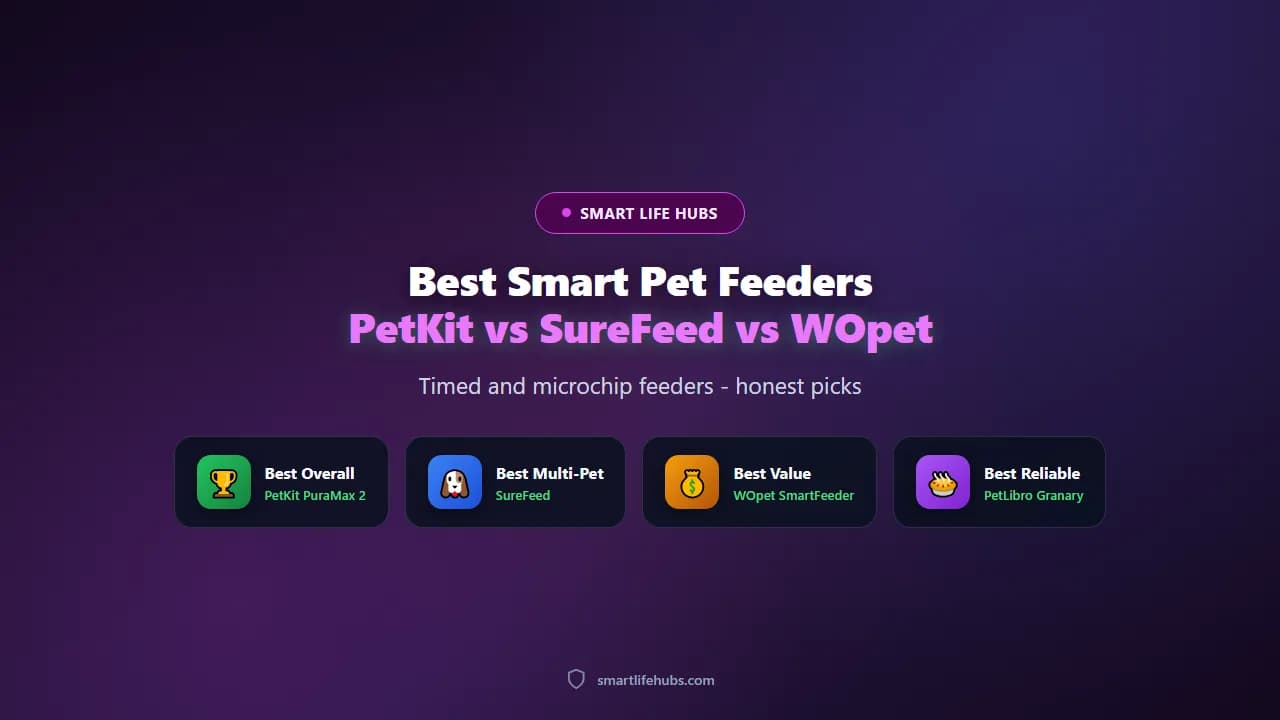
| PetKit PuraMax 2 | Best overall | 6L hopper, app, twist-lock lid, battery backup | About 120 to 160 USD |
| SureFeed Microchip | Best multi-pet | Sealed bowl, reads 32 microchips, no app needed | About 130 to 180 USD |
| WOpet SmartFeeder | Best value | 6L hopper, 1080p camera, 15 meals a day | About 60 to 90 USD |
| PetLibro Granary | Best reliability | 5L hopper, no hub, battery and USB power | About 60 to 90 USD |
| PetSafe Smart Feed | Best simple app | 6L hopper, app, battery backup, slow feed | About 100 to 140 USD |
The best smart pet feeders of 2026
1. PetKit PuraMax 2, best overall
The PuraMax 2 is the pick if you want a timed feeder that actually handles a large kibble and keeps the food fresh. It has a 6 litre hopper, a twist-lock lid with a desiccant tray, a gear-driven dispense mechanism that is more accurate than the rotating auger on most budget feeders, and a battery backup so it keeps working if the power fails. The app schedules meals and reports when the hopper is low, and it costs about 120 to 160 dollars. The honest trade-offs are a hopper that needs regular cleaning, an app that is busier than it needs to be, and a dispense accuracy that is good rather than laboratory-precise.
Pros
- 6L hopper with a twist-lock lid and a desiccant tray
- Battery backup so a power cut does not skip a meal
- About 120 to 160 dollars
Cons
- App is busy and the portion accuracy is approximate
- Hopper needs regular cleaning to keep food fresh
Check today’s price on Amazon.
2. SureFeed Microchip, best multi-pet
The SureFeed is the pick if one pet steals another’s food or one animal is on a prescription diet, because it is not a timed feeder at all. It is a sealed bowl with a motorised lid that reads your pet’s microchip or an RFID collar tag and opens only for that pet, then closes a few seconds after they walk away. It stores up to 32 identities, it runs about six months on four C batteries, and it costs about 130 to 180 dollars. The honest trade-offs are that it does not dispense portions on a schedule, it needs a separate training mode for a timid pet, and it is more expensive than a timed feeder, so it is the specialist tool rather than the everyday one.
Pros
- Opens only for the registered microchip or collar tag
- Sealed bowl keeps wet food fresh and blocks thieves
- Up to 32 pets and about six months on four C cells
Cons
- Not a scheduled portion feeder
- About 130 to 180 USD, and training takes a few days
Check today’s price on Amazon.
3. WOpet SmartFeeder, best value
The WOpet is the pick if you want a timed feeder with a camera for the least money. It has a 6 litre hopper, scheduling for up to fifteen meals a day, a ten-second meal call you can record, and a 1080p camera so you can check the bowl from work. It runs on three D batteries if the power fails, and it costs about 60 to 90 dollars. The honest trade-offs are a portion accuracy that is looser than the PetKit, a camera that is useful rather than sharp, and an app that is functional rather than polished, so it is the pick for a budget buyer who still wants the camera.
Pros
- About 60 to 90 dollars with a 1080p camera
- Up to 15 meals a day and a recorded meal call
- Battery backup on three D cells
Cons
- Portion accuracy is looser than the PetKit
- App is functional rather than polished
Check today’s price on Amazon.
4. PetLibro Granary, best reliability
The Granary is the pick if you want a feeder that simply works without a hub or a subscription. It has a 5 litre hopper, a stainless steel bowl, a clear portion dial on the body, and it runs on a battery and a USB power supply, so it keeps working through a power cut. It costs about 60 to 90 dollars, and the honest trade-offs are a simpler app, no camera and a plain design, so it is the pick for a household that wants reliability over features.
Pros
- About 60 to 90 USD with no hub and no subscription
- Battery and USB power with a stainless steel bowl
- Simple portion dial on the body
Cons
- No camera and a simpler app
- Plainer design than the PetKit or the WOpet
Check today’s price on Amazon.
5. PetSafe Smart Feed, best simple app
The PetSafe is the pick if you want the calmest app and a feeder from a brand with a long pet-product history. It has a 6 litre hopper, a twist-lock lid, scheduling and a slow-feed mode that dispenses a meal over fifteen minutes so a fast eater cannot gulp it, and it costs about 100 to 140 dollars. The honest trade-offs are a Wi-Fi setup that needs a 2.4GHz network, no camera and a design that is more functional than attractive, so it is the pick for a household that values a simple, calm app and does not want to learn a new one.
Pros
- Slow-feed mode spreads a meal over 15 minutes
- 6L hopper with a twist-lock lid and battery backup
- About 100 to 140 dollars
Cons
- Needs a 2.4GHz Wi-Fi network
- No camera and a plain design
Check today’s price on Amazon.
How to choose a smart pet feeder
Start with the problem, because that decides the category. If you want to feed on a schedule and be able to check the bowl from work, buy a timed feeder with a camera and a battery backup. If one pet steals another’s food or one animal needs a separate diet, buy a microchip feeder and accept that it is not a scheduled portion device.
Then check the hopper and the kibble size, because a feeder is specified for a maximum kibble diameter and a large kibble will jam a narrow path. Measure the kibble you use and buy a feeder rated for it, and look for a wide food path and a battery backup, because the jam and the power cut are the two ways a feeder fails at the worst moment.
Check the bowl and the cleaning, because a feeder with a sealed bowl and a stainless steel insert is easier to keep hygienic than one with a plastic bowl that traps grease. A plastic bowl that is not washed regularly can contribute to feline chin acne, so if your pet is prone to it, buy the stainless option and wash it weekly.
Think about the app and the connectivity, because a feeder that needs the cloud to dispense is a feeder that fails when your internet does. Look for local scheduling that survives a network drop, and check whether the app needs a subscription for the features you want. A camera is nice, but it is not worth a monthly fee for most people.
Finally, be honest about whether you need a smart feeder at all, because a simple gravity feeder or a timed mechanical feeder is far cheaper. A smart feeder buys you scheduling, a camera and portion control, and it costs sixty to one hundred and eighty dollars plus the electricity. If you feed once a day and you are home, the basic option is enough. The Consumers Guide 2026 roundup at theconsumers.guide/reviews/best-automatic-pet-feeders-timed-meals-2026 covers the portion accuracy and the camera models in more detail.
Living with a smart feeder
Run the feeder empty for a day before you rely on it, because a feeder that is not calibrated will over- or under-dispense. Weigh what it dispenses against the portion you intended, adjust the setting, and repeat until it is close. Ten minutes of calibration saves a season of under-fed or over-fed pets.
Keep the hopper sealed and the desiccant fresh, because dry food goes stale and rancid in a warm kitchen. Empty and wash the hopper every few weeks, replace the desiccant when it saturates, and do not top up a hopper that still has old food in the bottom, which is how mould gets in.
Test the battery backup on a schedule, because a battery that has been in the feeder for a year may not hold enough charge to cover a power cut. Replace the batteries at the start of every season rather than waiting for the low-battery warning, and keep a spare set.
Use the camera to check, not to worry, because a camera on a feeder will show you a pet that is bored, or a bowl that is empty, or a feeder that has jammed. Check once or twice a day, and if you find yourself watching constantly, turn the notifications off and trust the schedule.
Watch the weight and the appetite, because a feeder hides a change in eating. If a pet starts leaving food, or eats much more, or the bowl is empty at odd times, that is a reason to call the vet rather than to change the schedule. For the wider pet range, our pet camera guide covers the cameras, and the water fountain guide covers hydration.
Frequently asked questions
Frequently Asked Questions
6For the app, schedules and camera, yes. A feeder with local scheduling and a battery backup will still dispense if the network drops, so look for that if your internet is unreliable. A microchip feeder like the SureFeed needs no app at all.
Only models designed for it. Most timed feeders are for dry or freeze-dried kibble, and a wet food will clog the mechanism. The SureFeed microchip feeder is the one designed for wet food, because it is a sealed bowl rather than a dispenser.
A feeder with a battery backup keeps dispensing on its schedule. A feeder without one stops, so check the specification before you buy, and replace the batteries at the start of each season rather than waiting for the warning.
Wash the bowl daily or every few days and empty and wash the hopper every few weeks. A plastic bowl that is not washed regularly can contribute to feline chin acne, so a stainless steel insert is worth having if your pet is prone to it.
For a multi-pet house where one animal steals another’s food, or where one is on a prescription diet, it is the only tool that solves the problem. For a single pet on a normal diet, a timed feeder does the job for less.
Most pets adjust within a few days, and a recorded meal call helps. A nervous pet may need the feeder placed further from the bed and a few days of running it empty so the noise is not associated with food.
The bottom line
Buy the PetKit PuraMax 2 at about 120 to 160 dollars if you want the best overall timed feeder, because the large hopper, the gear-driven dispense and the battery backup make it the most capable everyday option.
Buy the SureFeed Microchip at about 130 to 180 dollars if you have a food thief or a pet on a prescription diet, because the sealed bowl that opens only for the registered pet is the only design that genuinely solves that problem. The WOpet at about 60 to 90 dollars is the value pick with a camera, and the PetLibro Granary at about 60 to 90 dollars is the one for reliability without a hub.
The one mistake to avoid is buying a timed feeder for a multi-pet diet problem, or a microchip feeder for a schedule. They are different tools, and the right one is decided by what your pet actually needs rather than by the feature list.