Best Smart Aromatherapy Devices of 2026 (App and Voice Controlled)
A smart aromatherapy device is a diffuser you control from a phone or a voice assistant. It either heats and disperses your own essential oils in water, or it blows air across a sealed fragrance capsule so there is no water to clean. The smart part is scheduling, intensity control, and automation, so a room smells the way you want at the time you want without you thinking about it. The hardware costs $20 to $235, and the capsule systems add a running cost.
The category splits into two camps, and the difference matters more than the price. Ultrasonic diffusers use water and your own oils, need weekly cleaning, and cost little upfront. Waterless capsule systems from Pura and Aera use sealed refills, need no cleaning, and cost more over time. There is no right answer, only the trade-off between flexibility and convenience, and most buyers pick based on whether they want to use their own oils.
The smart features are the reason to pay more than a basic diffuser. Scheduling means the scent is already in the room when you walk in, intensity control means you can run it gently in a small bedroom or harder in a living room, and automation means it can follow a routine or react to another device. None of that matters if the hardware is loud or the app is unreliable, so the reviews below weigh the smart features against the basics of scent, cleaning, and running cost.
I compared manufacturer specifications and independent roundups from Smart Home Unlocked, Vapor Reviews, and Business Insider Selects, which tested nine diffusers with an aromatherapy specialist. Where a figure is a claim rather than a measurement, I say so. Prices are as of November 2026.
At a glance
| Product | Best for | Key specs | Price |
|---|---|---|---|
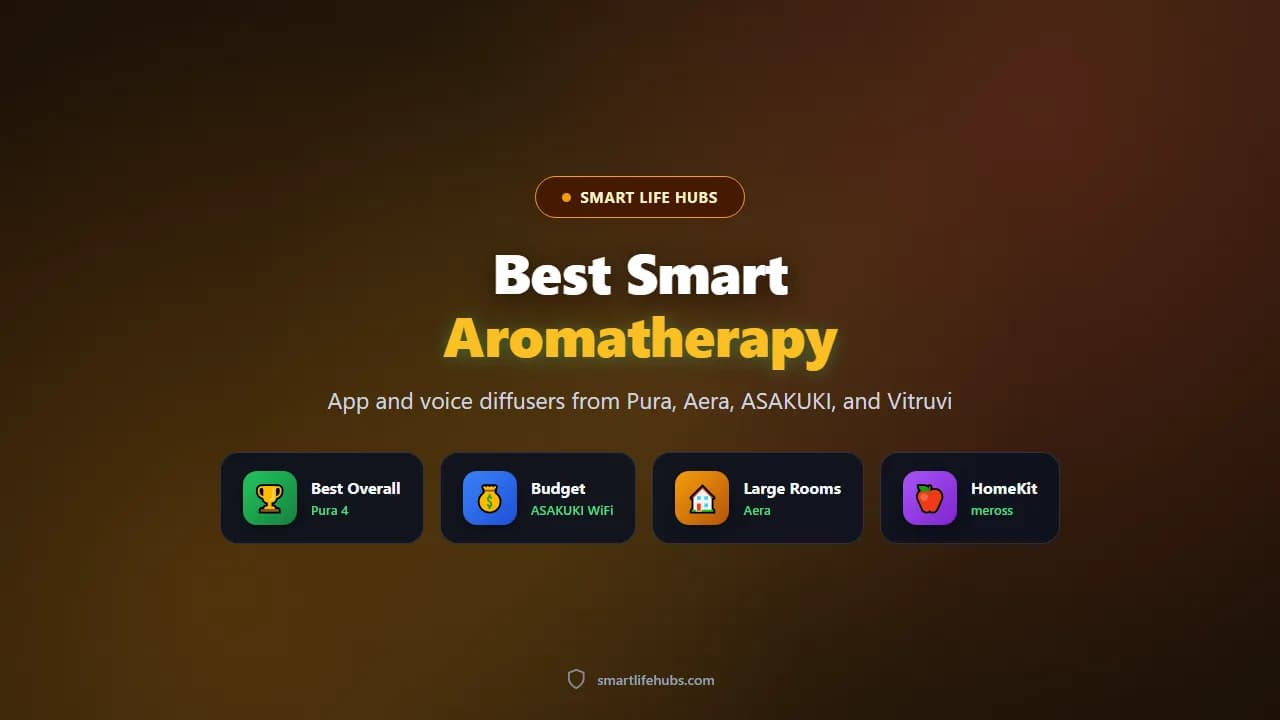
| Pura 4 | Best overall | Waterless, two vials, app scheduling, temperature aware | $49.99 |
| ASAKUKI WiFi | Best budget | Ultrasonic, 500 mL, your own oils, Alexa and Google | $19.99 to $41 |
| Aera | Best for large rooms | Waterless capsules, 500 to 1,000 sq ft, app and Alexa | $235 |
| Vitruvi Air | Best own-oil waterless | Waterless, 1,500 sq ft, cordless option, your own oils | $149.99 |
| meross WiFi | Best for Apple HomeKit | Ultrasonic, 400 mL, HomeKit, Alexa, Google, SmartThings | About $50 |
The best smart aromatherapy devices of 2026
1. Pura 4, best overall
The Pura 4 is $49.99 and it is the smartest balance of price, convenience, and control. It is a waterless plug-in that holds two fragrance vials at once, so you can alternate or blend scents, and it detects which refill you have installed and updates the app automatically. The app handles scheduling, intensity, and a dimmable night light, and it monitors room temperature to keep output steady between a cold bedroom and a warm one. Pura claims up to 120 hours per vial, and the refills come from a wide range of fragrance and candle brands. It works with Alexa and Google, though not HomeKit, and it plugs into a wall outlet rather than sitting on a table. The catch is the closed system: you cannot use your own essential oils, and refills cost more than a bottle of oil. Business Insider Selects picked it as the smart option in a nine-unit test. If you want scheduled scenting with no cleaning, it is the default.
A vial rated at 120 hours lasts about a month if you run the device for four hours a night, which is a useful way to think about the running cost. The two-vial design means you can keep a second scent ready and switch between them without buying a second unit.
- Pros: $49.99; two vials; app scheduling and intensity; temperature compensation; no cleaning
- Cons: Proprietary refills; no HomeKit; wall plug only; no published coverage figure
Check today’s price on Amazon.
2. ASAKUKI WiFi, best budget
The ASAKUKI WiFi diffuser costs $19.99 to $41 depending on capacity, and it is the cheapest way to get app and voice control. It is an ultrasonic unit with a 500 to 700 mL tank, so it runs for many hours on a fill, and it takes any essential oil you own. It connects through the Tuya app with Alexa and Google support, and it offers timers and mist levels. Independent testing scores it around 7 out of 10, noting that the app can be flaky and that scent throw is modest beyond its rated 269 to 322 square feet. Business Insider Selects chose the Asakuki 500 mL as its top pick overall in a nine-unit test, which says something about value. The trade-offs are the water tank, which needs weekly cleaning to avoid residue, and the weaker smart-home reliability. If you want your own oils on a tight budget, it is the pick.
The tank needs weekly cleaning, and the routine is simple: empty it, wipe the inside, and run a little vinegar through it to dissolve the oil film, then rinse and dry. Set a schedule in the Tuya app so the diffuser runs in the hour before bed rather than all day, which stretches the oil and keeps the scent from fading into the background.
- Pros: From $19.99; large tank; your own oils; Alexa and Google; strong value
- Cons: Requires cleaning; app can be flaky; modest throw beyond small rooms
Check today’s price on Amazon.
3. Aera, best for large rooms
The Aera is $235 for the Wi-Fi model, with a $95 plug-in Mini that has no published app control, and it is the premium waterless option. It uses sealed capsules and a micro-dispersion system to fill 500 to 1,000 square feet with scent, which is more coverage than any ultrasonic here, and it runs from an app or Alexa with scheduling and intensity. The design is the nicest in the group, it is quieter than the plug-in rivals, and there is no water and no cleaning. Independent testing scored it 8.5 out of 10 for clean, room-filling scent, while noting occasional app connectivity hiccups and some reports of oily residue or capsule leaks. The honest criticism is the cost: $235 is $185 more than a Pura 4 that already schedules, and the capsules are a permanent running cost. If you want the best scent in a large room and you dislike cleaning, it is the upgrade.
Place it across the room rather than next to the bed, because the micro-dispersion system is designed to fill a space rather than sit under your nose. A capsule used for a few hours each evening lasts weeks rather than days, which is the trade for the $235 price and the quieter motor.
- Pros: 500 to 1,000 sq ft coverage; no water or cleaning; app and Alexa; quiet
- Cons: $235; proprietary capsules; app hiccups; capsule leaks reported
Check today’s price on Amazon.
4. Vitruvi Air, best own-oil waterless
The Vitruvi Air is $149.99, or $184.99 for the cordless version, and it is the rare waterless diffuser that works with your own essential oils. It claims 1,500 square feet of coverage, which is the highest figure here, and it uses a refill pod you fill yourself rather than a sealed capsule, so you keep the flexibility of ultrasonic units without the water tank. The design is minimal and furniture-friendly, and the cordless version lets you move it between rooms. The trade-offs are the price, the fact that neither the maker nor the coverage claim is independently verified, and the lack of the deep app ecosystem that Pura and Aera have. If you want waterless convenience and your own oils, it is the best fit.
- Pros: Uses your own oils; waterless; claims 1,500 sq ft; cordless option
- Cons: $149.99 to $184.99; limited smart features; coverage claim unverified
Check today’s price on Amazon.
5. meross WiFi, best for Apple HomeKit
The meross WiFi diffuser costs about $50 and it is the pick if you live in the Apple ecosystem. It is an ultrasonic unit with a 400 mL tank that takes your own oils, and it supports HomeKit alongside Alexa, Google, and SmartThings, which no other diffuser here does. It offers timers, mist levels, and scheduling, and the price is close to the ASAKUKI. The trade-offs are the smaller tank, the need for cleaning, and the fact that it has less brand recognition and fewer independent reviews than Pura or ASAKUKI. If HomeKit support is the deciding factor, it is the only real option.
- Pros: HomeKit plus Alexa, Google, and SmartThings; 400 mL tank; about $50
- Cons: Requires cleaning; smaller tank; less reviewed than rivals
Check today’s price on Amazon.
How to choose a smart aromatherapy device
Decide between your own oils and a closed system. Ultrasonic diffusers take any oil and cost less upfront, but you clean a water tank weekly. Capsule systems from Pura and Aera need no cleaning but lock you into refills. If you like blending your own scents, buy ultrasonic. If you want zero maintenance, buy a capsule system.
Match the coverage to the room. Aera claims 500 to 1,000 square feet, Vitruvi Air claims 1,500, and most ultrasonic units are rated for 250 to 320. Manufacturers rarely publish coverage, so treat the numbers as indicative. A diffuser that fills a bedroom will be lost in an open-plan living room.
Check the smart-home ecosystem. Pura works with Alexa and Google, Aera with Alexa, ASAKUKI with Alexa and Google through Tuya, and meross is the only one with HomeKit. If you are an Apple household, the choice is essentially made for you.
Count the running cost. Pura claims 120 hours per vial and Aera capsules last weeks, but both are proprietary. A bottle of essential oil costs $10 to $20 and lasts a long time in an ultrasonic. Over two years, a $50 ultrasonic with your own oils is usually cheaper than a $235 capsule system.
Do not expect health claims. Aromatherapy is pleasant and may help you relax, but the evidence for treating medical conditions is weak, and essential oils can irritate pets and sensitive people. Keep diffusers out of reach of children and animals, and ventilate the room.
Plan where the device will live. A diffuser needs a wall outlet and a flat surface away from curtains and furniture that can stain. Put an ultrasonic unit where you can reach the tank easily for refilling and cleaning, and put a capsule unit where the scent can drift across the room rather than straight up at the ceiling. Essential oil can mark wood and fabric, so give the device its own small tray or mat.
Think about noise and light. Ultrasonic diffusers are nearly silent, with only the occasional faint hum or gurgle, and most have a light you can turn off. Capsule systems are also quiet, and the Pura 4 has a dimmable night light. If you are a light sleeper, check that the indicator light can be switched off, because a small LED in a dark bedroom is enough to annoy some people.
Check the refill ecosystem before you commit. A closed system is only as good as its refills. Pura has the wider range of refills here, while Aera uses its own capsules, so check that the scents you like are actually available where you live. If a brand discontinues a scent or changes its formula, you are left with a device you cannot refill.
Think about the wider air-quality picture. A diffuser changes how a room smells, not how clean the air is. If you want the air itself improved, our smart air purifier roundup and smart humidifier guide cover the devices that actually filter and humidify.
Frequently asked questions
Frequently Asked Questions
6Most do. Pura, ASAKUKI, Aera, and meross all support Alexa, and all except Aera support Google. meross is the only one here with Apple HomeKit. Voice control usually means on/off, intensity, and scheduling, not custom blends.
The Pura 4 for most people at $49.99, because it schedules, holds two scents, and needs no cleaning. The ASAKUKI WiFi if you want your own oils for under $40. The Aera if you want the best scent in a large room.
They are more convenient and need no cleaning, but they lock you into proprietary refills and cost more over time. Ultrasonic units take any oil and are cheaper to run, at the price of weekly cleaning.
Only in models designed for it, such as the Vitruvi Air, which uses a refill pod you fill yourself. Pura and Aera require their own sealed refills and cannot take standard essential oil bottles.
Some oils are toxic to cats and dogs, including tea tree, eucalyptus, and peppermint, and diffusers spread them into the air. Ventilate the room, keep the diffuser out of reach, and ask a vet before using oils around pets.
Every few days to weekly, with water and a little vinegar or rubbing alcohol, and dry it fully. Stagnant water grows mould and bacteria, which then gets dispersed into the air.
The bottom line
Buy the Pura 4 if you want the best all-round smart diffuser: $49.99, two vials, app scheduling, temperature compensation, and no cleaning. Buy the ASAKUKI WiFi if you want your own oils for under $40. Buy the Aera if you want the strongest scent in a large room and you accept the $235 price and the refills. Buy the Vitruvi Air if you want waterless convenience with your own oils. Buy the meross if you need HomeKit. The honest summary is that the closed systems win on convenience and the ultrasonic units win on running cost and flexibility, and for most people the Pura 4 is the one to get. Which one fits your home? Tell us in the comments.