Best Scalp Massagers of 2026 (Electric, Silicone, and Shampoo Brushes)
Best scalp massagers of 2026 are the small electric and manual tools that work the tension out of the scalp, and the honest finding after using them through a stressful stretch is that they are a genuine relief for a tight, tired head rather than a hair growth treatment. They are cheap, they take two minutes and they are one of the few wellness gadgets that do exactly what the packaging says.
The second thing to understand is that a scalp massager is not a medical device. It increases blood flow to the area in the short term and it relaxes the muscles around the skull, which can ease a tension headache and make washing your hair feel better. It will not regrow hair, and the claims that it does are not supported. Buy it for relaxation and for the wash-day routine, not for a transplant alternative.
Prices below are US retail captured in November 2026 and they move with sales.
At a glance
| Product | Best for | Key specs | Price |
|---|---|---|---|
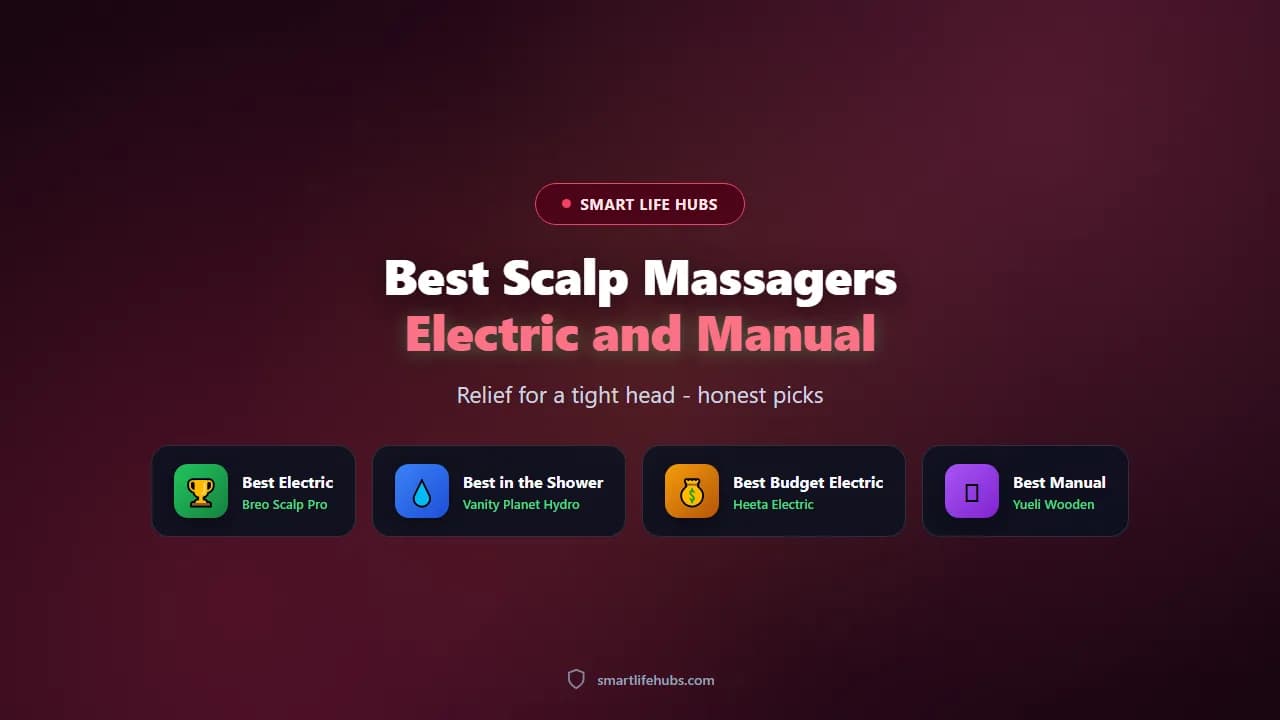
| Breo Scalp Pro | Best electric | Kneading nodes, waterproof, rechargeable | About 60 to 90 USD |
| Vanity Planet Hydro Scalp Massager | Best in the shower | Waterproof, silicone bristles, manual | About 20 to 40 USD |
| Heeta Electric Scalp Massager | Best budget electric | Kneading heads, waterproof, handheld | About 25 to 40 USD |
| Yueli Wooden Scalp Massager | Best manual | Wooden bristles, no battery, portable | About 10 to 20 USD |
| Therabody TheraFace PRO | Best multi-tool | Massage plus microcurrent and LED | About 399 USD |
The best scalp massagers of 2026
1. Breo Scalp Pro, best electric
The Breo is the pick if you want a proper electric massage, because its kneading nodes work the scalp with a rotating pressure that feels closer to a person’s fingers than a vibration. It is waterproof so you can use it in the shower, it is rechargeable and it has a handle that suits a full-head session, at about 60 to 90 dollars. The honest trade-offs are a plastic body, a noise level that is noticeable in a quiet bathroom, and a need to charge it, so it is the pick for someone who wants the strongest massage and will use it regularly.
Pros
- Kneading nodes that mimic finger pressure
- Waterproof and rechargeable with a comfortable handle
- About 60 to 90 dollars
Cons
- Noticeable noise and a plastic body
- Needs charging and is bulkier than a manual tool
Check today’s price on Amazon.
2. Vanity Planet Hydro Scalp Massager, best in the shower
The Hydro is the pick if you want a tool that works with your shampoo, because its soft silicone bristles are designed to be used on a wet scalp in the shower, where the warm water and the shampoo do most of the work. It is manual, it has no battery and it costs about 20 to 40 dollars. The honest trade-offs are a pressure that is limited to what your hand applies, a small body that can be fiddly to grip with wet hands, and a design that suits the wash routine rather than a dry massage, so it is the pick for the shower.
Pros
- Designed for use in the shower with shampoo
- About 20 to 40 USD with no battery
- Soft silicone bristles that are easy to clean
Cons
- Manual pressure only
- Small grip that can be slippery when wet
Check today’s price on Amazon.
3. Heeta Electric Scalp Massager, best budget electric
The Heeta is the pick if you want an electric massage for the least money, because it has kneading heads, a waterproof body and a handheld shape at about 25 to 40 dollars, which is a fraction of the Breo. The honest trade-offs are a weaker motor, a build that is less tough, and a device that is better on the crown than the back of the head, so it is the pick for a first try or a travel bag.
Pros
- About 25 to 40 USD, the cheapest electric here
- Kneading heads with a waterproof body
- Handheld and easy to pack
Cons
- Weaker motor and a less tough build
- Reaches the crown more easily than the back
Check today’s price on Amazon.
4. Yueli Wooden Scalp Massager, best manual
The Yueli is the pick if you want a simple wooden tool with no battery, because its soft wooden bristles give a gentle stimulation that is enough for a daily routine and it costs about 10 to 20 dollars. The honest trade-offs are a pressure limited to your hand, a tool that is less effective on thick hair, and a design that is more traditional than high-tech, so it is the pick for a buyer who wants the cheapest option and a quiet one.
Pros
- About 10 to 20 USD, the cheapest here
- No battery and no noise
- Small enough for a desk or a travel bag
Cons
- Manual pressure only and less effective on thick hair
- Traditional design with fewer features
Check today’s price on Amazon.
5. Therabody TheraFace PRO, best multi-tool
The TheraFace Pro is the pick if you already want a facial device, because it adds a scalp and facial massage to microcurrent and LED in one handheld at about 399 dollars. The honest trade-offs are a price far above a dedicated scalp tool, a massage head that is smaller than a purpose-built massager, and a device that is overkill if the scalp is your only concern, so it is the pick for a buyer who wants the whole facial routine.
Pros
- Massage, microcurrent and LED in one device
- About 399 dollars
- Good for a mixed facial routine
Cons
- About 399 USD, the priciest here by far
- Smaller massage head than a dedicated tool
Check today’s price on Amazon.
How to choose a scalp massager
Start with the routine, because that decides the type. If you want the massage as part of washing your hair, a waterproof manual tool like the Hydro is the simplest. If you want a dry massage at a desk or in front of the television, an electric kneading device like the Breo is more effective. If you travel often, a small manual tool or a compact electric is the practical choice.
Then check the pressure and the intensity, because the benefit comes from working the tissue rather than tickling it. A kneading electric gives the strongest and most consistent pressure, a manual tool gives you control but less force, and a vibrating device is the gentlest. If you have a tension headache, buy the kneading type.
Check the grip and the reach, because a tool you cannot hold comfortably will not be used. A handle that suits a full-head session matters if you want to reach the back of the scalp, and a small brush-style tool is easier for the crown. Try the shape in the hand before you commit.
Think about the noise and the cleaning, because a massager used in a quiet bedroom or a shared bathroom needs to be tolerable, and a tool used on a dirty scalp needs to be washable. A waterproof body is useful in the shower, and a silicone brush is easier to clean than a plastic one with crevices.
Finally, be honest about the claim, because a scalp massager relaxes and comforts rather than regrowing hair. If your concern is hair loss, a laser device or a conversation with a dermatologist is the relevant step, and the massager is a comfort tool alongside it. Healthline’s guide to head massage at healthline.com/health/head-massage-benefits covers the evidence for tension headaches and the limits of the hair growth research.
Living with a scalp massager
Tension, technique and limits
The benefit of a scalp massage is largely about tension, and the evidence for it is real but modest. Studies of massage for tension-type headache show a reduction in frequency rather than intensity, and a small study found thicker hair after 24 weeks of daily scalp massage, though that is a long way from a treatment. Use the device for what it reliably does, which is relax a tight head, and treat the hair growth claims with caution.
Work with the muscles rather than the hair, because the tension sits in the tissue around the skull. Spend time at the base of the skull, behind the ears and at the temples, use slow circular pressure rather than fast scratching, and breathe out as you press. A two-minute session with attention beats five minutes of impatient scrubbing.
Routine and care
Keep the tool clean and dry, because a scalp massager touches the skin directly and will pick up oil and product. Rinse a silicone brush after every use, wipe an electric head with a damp cloth rather than submerging it unless the manual says it is safe, and store it somewhere it will not be dropped on a tiled floor.
Pair the tool with the habits that cause the tension, because a massager will not undo a day at a bad desk. Check the screen height, drink enough water, take a break from the headphones and stretch the neck, and use the massager as the release when the working day closes rather than the only thing you do.
Use it on a clean scalp or in the shower, because oil and product build-up will drag on the hair and pull, and a dirty tool will spread it. Wash the hair before a dry session, and rinse the tool after every use so the bristles stay clean and do not irritate the skin.
Start gently and build the pressure, because a scalp that is tight or tender will bruise if you go hard in the first session. Use the lightest setting for a minute, then increase over the week, and stop if you feel pain rather than pressure. A good session feels like a firm hand, not a scratch.
Work in sections rather than one long sweep, because the scalp has several areas that hold tension differently. Do the crown, the temples, behind the ears and the base of the skull, and spend a little longer where you feel the tightness. Two to five minutes is enough, and more is not better.
Use it alongside the other tension habits, because a massager helps a tight scalp but will not fix a headache caused by dehydration, a bad pillow or a screen that is too high. Pair it with water, a neck stretch and a screen break, and keep the tool for the relief it actually gives.
Charge it before it is flat and store it somewhere dry, because a massager left on a wet shelf will corrode the contacts. Keep the attachments together, replace the brush head when the bristles wear, and clean the charging port occasionally.
For the wider range, our neck massager guide covers the larger tools, and the massage gun guide covers the body work.
Frequently asked questions
Frequently Asked Questions
6Not directly. It increases short-term blood flow and relaxes the muscles around the skull, which can ease tension, but there is no good evidence that it regrows hair. If hair loss is the concern, look at a laser device or a dermatologist.
Two to five minutes a day is plenty, and most people use one in the shower or in the evening. More time is not better, and a tender scalp needs less pressure rather than more.
For some people, yes. Working the temples, the base of the skull and the neck can ease a tension-type headache, though it will not help a migraine or a headache with another cause. Stop if it makes the pain worse.
Electric gives a stronger, more consistent pressure and suits a tension headache, while a manual tool is cheaper, quieter and easier to control. Buy electric for the massage and manual for the shower or the budget.
Yes, with less pressure and a softer head. A scalp with psoriasis, eczema or a recent injury should be treated gently, and you should avoid broken skin. If a condition is active, ask a clinician first.
Not usually. On a dry scalp a little oil can reduce drag, and in the shower the shampoo is enough. Avoid heavy oil on fine hair, which will make it greasy, and clean the tool afterwards.
The bottom line
Buy the Breo Scalp Pro at about 60 to 90 dollars if you want the best electric massage, because the kneading nodes give a pressure that actually works the scalp and the waterproof body suits the shower.
Buy the Vanity Planet Hydro at about 20 to 40 dollars if you want a tool for the wash routine, the Heeta at about 25 to 40 dollars if you want an electric massage on a budget, and the Yueli wooden tool at about 10 to 20 dollars if you want the simplest quiet option.
The honest point is that a scalp massager is a comfort tool rather than a treatment. It will ease a tight head and make washing your hair feel better, and it will not regrow hair, so buy it for relaxation and pair it with the treatments that address the actual problem.