Best Red Light Therapy Masks of 2026 (Omnilux vs CurrentBody vs Dennis Gross)
A red light therapy mask is a silicone or plastic face covering with LEDs that shine red and near-infrared light onto your skin, and the category has matured quickly. The current masks are flexible enough to wear while you work, cleared for full-face wrinkles, and good enough that the differences are now about wavelengths, session length and comfort rather than whether the concept works at all.
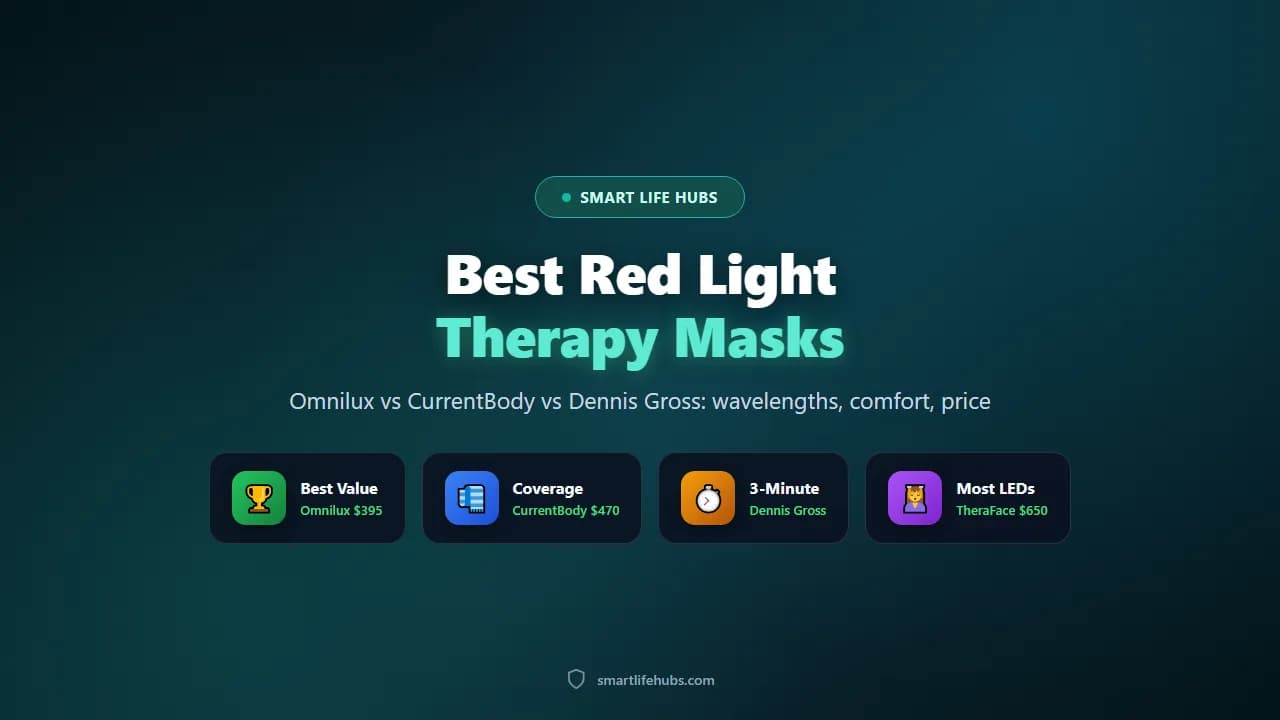
Prices run from about $349 to $649.99. The Omnilux Contour Face at $395 is the best value and carries a two-year warranty. The CurrentBody Skin Series 2 at $469.99 adds a third deep near-infrared wavelength and a chin wrap. The Dr. Dennis Gross FaceWare Pro at $455 runs a three-minute session and adds blue light for acne.
I pulled Biology Verdict’s five-way comparison with FDA filing numbers, ONDA Life’s head-to-head, Glamour’s tested roundup, and The Verdict Lab’s ranked guide. Where a figure is a claim rather than a measurement, I say so. Prices are US street prices as of November 2026.
At a glance
| Product | Best for | Key specs | Price |
|---|---|---|---|
| Omnilux Contour Face | Best value | 633 and 830 nm, 132 LEDs, 10-minute sessions, 2-year warranty | $395 |
| CurrentBody Skin Series 2 | Best coverage | 633, 830 and 1072 nm, 236 LEDs, chin and neck flap | $469.99 |
| Dr. Dennis Gross FaceWare Pro | Best for acne | Red plus blue 415 nm, 162 LEDs, 3-minute sessions | $455 |
| HigherDOSE Red Light Mask | Best returns | 630 and 830 nm, 132 LEDs, 120-day returns, 10 or 20 minutes | $349 |
| Therabody TheraFace Mask | Best features | 633, 830 and 415 nm, 648 LEDs, 17 vibration motors | $649.99 |
The best red light therapy masks of 2026
1. Omnilux Contour Face, best value
The Omnilux Contour Face costs $395 and it is the mask that keeps winning on value. It uses 633 nanometre red and 830 nanometre near-infrared light from 132 LEDs in 66 bulbs, runs 10-minute sessions three to five times a week, and carries a two-year warranty on both the mask and the controller. Biology Verdict gives it the edge on warranty and price, and The Verdict Lab rates it 9.6 out of 10 as the best overall mask.
The trade-offs are the narrowest feature set here: only two light modes, no neck coverage in the base configuration and a 30-day return window with a $15 fee that does not clearly cover a used mask. If you want simplicity and the longest warranty, it is the pick.
- Pros: $395; 633 and 830 nm; 2-year warranty on mask and controller; flexible silicone
- Cons: Two modes only; neck flap sold separately; $15 return fee
Check today’s price on Amazon.
2. CurrentBody Skin Series 2, best coverage
The CurrentBody Skin Series 2 costs $469.99 and it is the mask for people who want the most complete treatment. It adds a third wavelength at 1072 nanometres for deeper near-infrared, uses 236 LEDs in flexible liquid silicone, and wraps under the chin, which ONDA Life names as the winner on neck coverage. Glamour calls it the best-fitting mask it tried and the best overall pick in its roundup.
The trade-offs are the price, the weight of the clip-on controller at 1,220 grams and a returns policy that is unopened only with you paying shipping, which is unhelpful if the mask does not suit you. It is FDA registered rather than cleared, and its 1072 nm LEDs are not described in the FDA filing, which covers only the 633 and 830 nm ones.
- Pros: $469.99; three wavelengths including 1072 nm; 236 LEDs; chin and neck flap
- Cons: Heavy controller; returns unopened only; third wavelength not in the FDA filing
Check today’s price on Amazon.
3. Dr. Dennis Gross FaceWare Pro, best for acne
The Dr. Dennis Gross DRx SpectraLite FaceWare Pro costs $455 and it is the mask with the shortest routine and the only one here with a blue light mode. It uses 100 red and 60 blue lights, runs three-minute sessions, is cordless with eight to ten sessions per charge, and pairs red anti-ageing with blue 415 nanometre light for acne. Glamour names it the best for acne.
The trade-offs are the rigid hard-shell design, which ONDA Life rates less comfortable than the flexible silicone masks, and the regulatory transparency. Biology Verdict could find no 510(k) number and no FDA listing under the FaceWare Pro name, and the brand publishes no output figures. It is called FDA cleared on the product page, but the paperwork is hard to verify.
- Pros: $455; 3-minute sessions; red plus blue 415 nm; cordless
- Cons: Rigid shell is less comfortable; no verifiable 510(k) number; no published output
Check today’s price on Amazon.
4. HigherDOSE Red Light Face Mask, best returns
The HigherDOSE Red Light Face Mask costs $349 and it is the cheapest mask here with the most generous returns policy: 120 days from delivery, even after use, with a prepaid label. It uses 630 nanometre red and 830 nanometre near-infrared light from 66 dual-core LEDs, runs 10 or 20 minute sessions and carries a one-year warranty. An independent comparison at USA Today ranked it the best overall mask of 2026.
The trade-offs are only two light modes, no neck coverage and a battery that cannot run while charging, with about 80 to 100 minutes per charge. If you want the lowest price and the safest way to try the category, it is the pick.
- Pros: $349; 120-day returns with prepaid label; 10 or 20 minute sessions
- Cons: Two modes; no neck coverage; cannot use while charging
Check today’s price on Amazon.
5. Therabody TheraFace Mask, best features
The Therabody TheraFace Mask costs $649.99 and it is the most feature-rich mask here. It combines 633 nanometre red, 830 nanometre near-infrared and 415 nanometre blue light from 648 LEDs, adds 17 vibration motors, runs nine-minute sessions with three minutes per mode and uses two 1,500 mAh cells with USB-C charging. Biology Verdict gives it the most LEDs and the vibration feature.
The trade-offs are the highest price, a one-year replacement-only warranty that excludes battery wear, and a plastic shell with silicone eye shields that is heavier than the flexible silicone masks. Buy it if you want the most functions and do not mind the cost.
- Pros: $649.99; 648 LEDs; red, near-infrared and blue; 17 vibration motors
- Cons: Most expensive; 1-year replacement-only warranty; heavier shell
Check today’s price on Amazon.
Living with a red light mask
The first thing you learn is that the mask only works if you wear it, and the second is that the timer is what makes the habit. A mask that switches itself off after the session removes the need to watch a clock, which sounds trivial and is actually the difference between a mask you use and one you intend to use.
The third thing is that flexible silicone wins on real life. A rigid shell has to sit exactly right to deliver even light, and if you shift in your chair the coverage changes. A flexible mask moves with you, which is why ONDA Life found the silicone options more comfortable and why compliance tends to follow comfort.
The fourth is the skincare interaction. Clean skin matters because anything opaque blocks the light, so the routine becomes cleanse, mask, then serum. Some people find the light dries their skin slightly, and a moisturiser afterwards helps.
The fifth is patience again. The changes people report, better tone, softer fine lines, calmer redness, appear after weeks rather than days, and they are subtle enough that you may not notice them until an old photo makes the comparison. Taking a picture at the start is the cheapest way to know whether it is doing anything.
Finally, think about storage and travel. These are awkward objects, and a mask that lives in a drawer will lose to one that hangs on a hook by the mirror. If you travel often, check that the controller and charger are small enough to pack without a dedicated bag.
The short version is that the device you will use on a tired evening is the right one, whatever the spec sheet says about its LED count.
There is also the question of when to use it. Most people settle on an evening session after cleansing, because the skin is clean and the ten minutes fit into an existing routine, and doing it at the same time each day is what makes it stick rather than letting it slide.
Pick a slot you already have, and the mask becomes a habit instead of a project.
How to choose a red light mask
Check the wavelengths. Most of the research uses red around 630 to 660 nanometres and near-infrared around 810 to 850 nanometres, which is what the Omnilux and CurrentBody provide. Extra wavelengths such as 1072 nanometres or blue 415 nanometres are plausible additions rather than proven upgrades.
Ask what the clearance actually covers. Several brands say FDA cleared, but Biology Verdict found the CurrentBody filing describes only two of its three wavelengths and could not find a 510(k) for the Dr. Dennis Gross mask at all. Check the filing number rather than the marketing line.
Prefer flexible silicone for comfort. A flexible mask sits flush against the skin and scatters less light than a rigid shell, and ONDA Life found the rigid Dr. Dennis Gross less comfortable for extended sessions. If you will wear it while working, comfort decides compliance.
Match the session length to your patience. A three-minute rigid mask is far easier to keep up than a ten-minute one, and consistency matters more than the extra minutes. If you know you will skip a ten-minute session, the shorter routine wins.
Read the returns policy carefully. The masks range from 120 days with a prepaid label at HigherDOSE to 30 days unopened only at CurrentBody. Since fit and comfort are personal, a generous return window is worth real money.
Think about the neck. If you want to treat the jawline and neck, the CurrentBody’s integrated flap is the only one here that includes it, and Omnilux sells one separately.
Keep expectations modest. The skin results on brand pages are their own studies, often without control groups. Red light is a plausible, low-risk addition to a skincare routine, not a substitute for sunscreen or a dermatologist.
Think about the rest of the kit. Our red light panel guide covers full-body devices, and our PEMF mat guide covers a different kind of home therapy.
Frequently asked questions
Frequently Asked Questions
6The Omnilux Contour Face at $395 for most people, with 633 and 830 nm light, a two-year warranty and the lowest price of the strong options. The CurrentBody Series 2 at $469.99 if you want a third wavelength and chin coverage, and the Dr. Dennis Gross FaceWare Pro at $455 if you want three-minute sessions and blue light for acne.
The evidence supports modest improvements in fine lines and wrinkles, and several masks are FDA cleared for full-face wrinkles. The skin results quoted on brand pages are usually the brand’s own studies, often without control groups, so treat them as encouraging rather than conclusive.
Most masks recommend three to five sessions a week, with 10 minutes per session for the flexible masks and 3 minutes for the Dr. Dennis Gross rigid mask. Consistency over months matters more than any single session.
If you want the 1072 nm deep near-infrared and the chin and neck flap, yes. Note that its FDA filing describes only the 633 and 830 nm LEDs, and its returns policy is unopened only.
Yes, and most people do. Clean skin is the main requirement, since sunscreen and makeup block light. Apply your usual serums afterwards rather than before, and keep the mask off broken skin.
The masks are designed to be used with eyes closed, and several include eye shields or inserts. Do not stare at the LEDs, and if you have a photosensitive condition or take medication that increases light sensitivity, ask a doctor first.
The bottom line
Buy the Omnilux Contour Face if you want the best value: $395, 633 and 830 nm light, 132 LEDs and a two-year warranty. Buy the CurrentBody Skin Series 2 at $469.99 if you want the third 1072 nm wavelength and chin coverage, the Dr. Dennis Gross FaceWare Pro at $455 if you want three-minute sessions and blue light for acne, the HigherDOSE at $349 if you want the cheapest entry with 120-day returns, and the Therabody TheraFace at $649.99 if you want the most features. Glamour’s tested LED face mask guide reached the same conclusion on the CurrentBody as the best fit. The honest summary is that the masks differ more in comfort, session length and warranty than in the light they produce, and the one you will use for ten minutes three times a week is worth more than the one with the most LEDs. Which feature matters most to you? Tell us in the comments.